Awkward Blog

Showing posts with label comic strips. Show all posts

Thursday, April 2, 2015


The Art of Richard Thompson book excerpt: Thompson and Bill Watterson talk comics some more


http://richardspooralmanac.blogspot.com/2015/04/the-art-of-richard-thompson-book.html

Wednesday, April 1, 2015

Not a hoax. Not a joke. Not an April Fool's day trick. Here's an excerpt of the conversation of Richard Thompson and Bill Watterson from The Art of Richard Thompson, which you can buy right now from Amazon or Barnes & Noble, or order and wait for a copy signed by Richard from One More Page.

BILL WATTERSON: When I was a kid, I loved Peanuts, so I wanted to be the next Charles Schulz. I didn’t understand what that meant of course, but it seemed like a plan. You came to your comic strip from a different path,
however.

RICHARD THOMPSON: Yeah. Off in my own little world of being a pretend cartoonist. Without a plan.

BW: So how did you envision cartooning? What was your experience of it as a kid?

RT: Well, Schulz pretty much defined “cartoonist.” But I remember in fifth grade, a friend’s older sister had some Pogo books and we spent the day poring over them. That was the first time I understood some of the jokes. It was pretty intimidating and dense for a kid.

RT: Yeah, mostly strips. Comic books were hard to find. And a strip is a one-person deal. Not like animation, where you’ve got to work with other people.

BW: As a kid, animation just seemed out of the question to me. I wouldn’t even know how to go about doing it.

RT: It was interesting. But even when I was old enough to maybe try it, I always hated the idea of working with others.

BW: Plus, you needed film equipment and all that.

RT: Yeah. Really, though, I did cartoons without any clear thought of having a future in it.

BW: Any other strips or cartoons that had any impact as a kid?

RT: Some strange ones. There was a panel called Mr. Tweedy about a hapless little guy. I don't remember who drew it. And there was Freddy by a guy who signed as Rupe. I think he was local.

BW: I don't know either one.

RT: I think it was probably in one paper. Also, Wizard of Id... BC... And Mad Magazine of course. I discovered that when I was probably ten.

BW: I remember there was some shock value in bringing Mad home.

RT: Right. (laughs) I remember the first time I picked it up in the grocery store and said I wanted to buy this. My parents looked at it and went ickkk. But my dad finally read it and started giggling. He had a good sense of humor, thankfully.

BW: My next-door neighbor bought it regularly, and he'd bring it over and I'd pore over the drawings. Eventually I worked up the nerve to ask my mom if I could get it. There were a number of years when I really thought Mad was the cat's pajamas, although now I think it was pretty formulaic. But even as a kid, it seemed out of the mainstream of cartooning. It was off in its own world.

RT: It seemed to open up this whole subculture.

BW: Could you imagine yourself doing something in that direction?

RT: Kinda vaguely.

BW: I could never see a way in. I couldn't imagine myself drawing movie and TV satires. I guess Don Martin did the closest thing to a regular cartoon, but in that grotesque style. Or Dave Berg's whatever....

RT: The Lighter Side Of (laughs). I'd often read it first. It was always so square!

BW: Right! So what did you respond to in Mad? What aspect?

RT: Oh, the art. The Aragones drawings in the margins and stuff like that. There was no one thing. Spy vs Spy, which was kind of exotic. And of course the parodies, where you discover caricature.

BW: I marveled at Mort Drucker, but I didn't see any road between here and there. At that age, my drawing skills were pretty much limited to drawing things in side-view outlines.

RT: I would try, but... I do remember seeing David Levine drawings of Nixon in like, sixth grade, in my classroom. My teacher was an anti-Nixonite. These beautiful, elegant drawings of Nixon--I remember being fascinated by it. He was using ink like paint, almost.

BW: What, the hatching?

RT: Yeah. So elegant.

BW: I never really responded to Levine. The likenesses were strong, but sort of like stone sculpture, or something- -not warm. I dunno. I remember Oliphant's caricatures really impressed me--so wild and cartoony, compared to Drucker. But getting a likeness is really hard. What made you want to do that?

RT: Caricature was something that'd always interested me. Later, as a freelancer, I thought the more arrows in my quiver the better. When I showed the art director at the Post, Mike Keegan, some pages of caricature sketches, he was delighted. I was suddenly taken more seriously too. I remember the British show Spitting Image had just premiered, and it gave me the kick I needed.

BW: Hm, I'm trying to think what else was in the air back then...

RT: I remember we had a bunch of New Yorker cartoon books in the classroom. This is like fifth or sixth grade. The teacher would bring them from home or something.

BW: OK, you moved in more sophisticated circles than I did!

RT: I didn't quite understand them. There's a Roz Chast drawing about her as a child finding Charles Addams cartoons, and I remember finding those too, and how gruesome they were. And the painting in them was soft and..

BW: The grays?

RT: Yeah, like no one else.

BW: I was probably a bit older when I saw New Yorkers. You know, if it was a cartoon, I'd jump to read it, but I don't remember them making much impact. Well, actually, I still like George Booth a lot. He's one of the few New Yorker cartoonists whose drawings are funny.

RT: I remember being impressed with New Yorker cartoons, but I probably didn't understand much.

BW: How about comic books? Nothing?

RT: Some. They were hard to find. I'd find them occasionally, and then I'd probably whine 'til I got them. If they were Batmans.

BW: Really, they were hard to find? My town had three drugstores that used to carry them, and I'd get them sometimes, but superhero comics didn't do a lot for me.

RT: Archie and whatnot... I had a few of those but I was never really into them.

BW: One summer my neighbor gave me this huge box of Archie comic books, and I read them in the car on some family vacation. I have no idea where he got them, but there were a zillion of the things, so my brother and I sat in the back seat reading one after another until it nearly killed us. We read ten thousand Archie comic books and they were all exactly the same.

RT: And the drawings are so clean.

BW: Yeah, very slick. Even then I thought they were dumb and outdated. It's a bizarre memory. How about underground comix? Did they have any impact on you?

RT: Some. I came late to undergrounds. I had friends who collected them (Henry Allen has Zap #0) but my main exposure was all in histories and anthologies. I liked, revered Crumb, though he is overwhelming, and thought Wonder Warthog was freaking hilarious.

BW: I saw some in college and I liked Wonder Warthog too, but on the whole, the undergrounds didn't make much connection. I preferred sillier, more cartoony stuff, I suppose.

What non-cartoon things made an impression on you as a kid?

RT: My folks liked doing things and making me a part of it. I remember when the Mona Lisa came to town. I was about six. We stood in line for a long time. Red draperies and guards every few feet, and then  ventually, there it is. My mom liked it a lot. The whole way, she was telling me what an important painting it was and the story of it. She had a great appreciation for culture. She didn’t have any great understanding of it so much as just liked it, I guess.

BW: Wow, I guess you’re one of the few people who’s ever seen it without a foot of bulletproof glass in front of it.

RT: I think so. You couldn’t get right up to it--there were velvet ropes. But you could breathe the same air. (BW laughs)

BW: I don’t remember much exposure to fine art--just the popular culture of the day. I think of my childhood as the Batman TV show, the Beatles, and the moon landings. Although I do remember in middle school there were a few years when I read all the Doctor Dolittle books. I loved those--the idea of talking to animals. A PETA sensibility ahead of its time. It probably had some subliminal influence on my strip. What aspects of pop culture did you participate in?

RT: Well yes, the moon landings and take-offs. You knew it was important when the teacher pushed the TV into the classroom.

Jump over to Richard's Cul de Sac blog for more discussion on comic strips.

Tuesday, March 23, 2010

Today's Chatalogical Humor is on Gene Weingarten's new comic strip "Barney & Clyde" as well as the quality of early Dennis the Menace.

Updating this a little, Barney and Clyde is a comic about a billionaire and a pauper. It's got a Facebook page now, and will be appearing in the Post when it launches.

Friday, March 19, 2010

A buddy of mine who lives in DC has been listing the webcomics he reads on his blog. He's up to 8 pages of lists. Obviously, he's more plugged in than I am.

Comic strips - part 1

Comic strips - part 2

Comic strips - part 3

Comic strips - part 4 - he wanders into the syndicated strips he reads here.

Comic strips - part 5

Comic strips - part 6

Comic strips - part 7

Comic strips - part 8

and he took in Short Animation Oscar nominees just for good measure.

Wednesday, December 2, 2009

I'm betting the comics aren't coming back, even though they're not mentioned in this article.

This has not been a good year for comic strips and editorial cartoons in the nation's capital. Perhaps I'll do a year-in-review post like everyone else does in December.

Tuesday, December 1, 2009

In 1966, the Detroit Free Press published some classic comics (Little Orphan Annie, Gasoline Alley, Gil Thorp, Terry and the Pirates, Nancy, Grin and Bear It, On Stage, Brother Juniper, Peanuts, Brenda Starr, Mutt & Jeff, Dick Tracy, BC, Mr. Mum, Peanuts, Judge Parker) and some not-so-classic ones (The Neighborhood, Smidgens, Fan Fare, The Ryatts, Ferdinand), but they also published a comics panel that appears to have been done by their staff artists.

Odd 'Change is a very small panel that appeared in the middle of the stock tables. Here's three examples:

May 6, 1966

March 25, 1966

March 3, 1966

I haven't been able to find any information on this panel, with an admittedly quick search of OSU and MSU's databases. It's not in Allan Holtz's excellent resource The Stripper's Guide either, although this post points out that the Free Press did do its own comic strips. The original clippings are being sent to MSU's Comic Art Collection. Join us again for another entry in... The Secret History of Comics!

Monday, November 30, 2009

The Washington Post's free Express paper was improved over the holiday and that means they cut 3 of the 5 comic strips they ran. Out are Bizarro by Dan Piraro, Cornered by Mike Baldwin, and The Duplex by Glenn McCoy. Remaining are Pearls Before Swine (which also appears in the Post) and Pooch Cafe, now in color.

Should you wish to question this improvement, you can write to inbox@readexpress.com

I will be doing so in a few minutes.

UPDATE: The editor wrote back to me to say, "We might feature fewer comics in our print edition now, but we've added an expanded comics section in an easy-access, newspaper-style format at our Web site, ExpressNightOut.com. You'll find Bizarro, Cornered and The Duplex there every day - plus a slew of new comics to make a visit worth your time. Those include Lio, Non Sequitur, The Argyle Sweater, Bound and Gagged, Candorville, Cul de Sac and the New Adventures of Queen Victoria. You can find them here: http://www.expressnightout.com/comics."

While I obviously don't agree with him, I appreciate the fact that he took the time to respond. I've just sent him a response which includes, "We'll have to agree to disagree though because if it's a commuting newspaper, then putting the comics online doesn't really help anyone except those with overly-smart phones. Besides the Post does that already. In the end, I just don't see providing less of something as a way to bring in more readers."

Monday, February 16, 2009

Alan Gardner is reporting a self-syndication seminar in Las Vegas that will feature the Post's Am Lago, among others. My own 2 cents, which is worth 2 cents, is that self-syndication, at least for newspapers, is collapsing around the ears of the alternate cartoonists. On the other hand, this has some successful strip and webcomics cartoonists who are making a living without being with a syndicate.

Tuesday, January 20, 2009

Verne from Over the Hedge probably gets the closest although Prickly City did ok too. The Rudy Park cast apparently hasn't heard that all the highways from Virginia are closed - maybe they're coming from Maryland where the roads stayed open? Secret Asian Man is watching it on tv.

And Curtis is in trouble! I never realized he lived in DC before, but he just took a bus into town so he must.

Sunday, September 28, 2008

See "Jenny's mission of mirth: Military spouse reaches out to her peers with comic strip," by Karen Goldberg Goff, Washington Times Sunday, September 28, 2008.

Julie Negron is the creator of "Jenny, the Military Spouse," which can be seen online at www.jennyspouse.com in addition to newspapers.

Wednesday, September 24, 2008

In his Tuesday chat, Weingarten was asked about F-Minus:

Providence, R.I.: The best comic strip in the Boston Globe, which I read as a poor shadow of a substitute for my native Post, is Tony Carrillo's "F-Minus." Are you familiar? What do you think, and can you get this brilliant man in the pages of the WaPo?

Gene Weingarten: I like it a LOT. I will see what I can do, which isn't much.

Monday, September 22, 2008

I had a truncated look at some paper ephemera while at the Farmer's Market this weekend and bought two postcards.

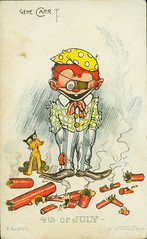
Carr - 4th of July

The first is by Gene Carr, who did various comic strips, as well as postcards. This one is 4th of July.

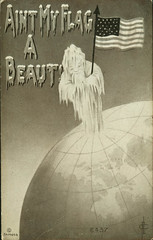
Aint' my flag a beaut

The second is Ain't My Flag A Beaut! postcard, a caricature of Old Man Winter or Jack Frost holding an American flag based on Robert Peary's trip to the North Pole in 1909.


Click through either one to see a larger version.

Monday, June 16, 2008

I have no inside knowledge, but Sunday's strip showed Dilbert and Wally being shown through the strip with a real estate agent saying "This space becomes available in two weeks." Today's strip was about a sense of something catastrophic about to happen. I hope the strip isn't ending as I like it just fine.

Tuesday, June 10, 2008

FOR IMMEDIATE RELEASE

June 6, 2008

The Special Collections Research Center (SCRC), Syracuse University Library has been awarded a grant of $79,440 by the National Historical Publications and Records Commission to support the arrangement and description of the library's 134 unprocessed collections of original cartoon art. The funds will help support a full-time project archivist for a period of two years. The award to Syracuse was one of six "Detailed Processing Grants" awarded by NHPRC and the Archivist of the United States. Other recipients included Princeton University and the University of Chicago.

Syracuse's collection of original cartoon art is among the most comprehensive in America. It includes original work by approximately 173 artists (more than 20,000 items) and comprises more than 1,000 linear feet of material. Spanning the course of the 20th century, it includes both serial and editorial cartoons. Among the serial cartoonists represented are: Bud Fisher, whose Mutt and Jeff was the earliest
successful daily comic strip; Mort Walker, whose Beetle Bailey anticipated the changing notions of American masculinity and militarism during the Cold War; Hal Foster, whose lavishly illustrated Prince Valiant elevated the artistic ambitions of the genre; and Morrie Turner whose Wee Pals was the first comic strip to chronicle the lives of racial and ethnic minorities in American life. The editorial and political cartoonists represented in the collection include: William Gropper, whose leftist political cartoons in the Daily Worker raised working class consciousness during World War II; F.O. Alexander, whose everyman alter-ego "Joe Doakes" experienced the turbulence of the 1960s in the pages of the Philadelphia Bulletin; and Carey Orr, whose editorial cartoons appeared in the Chicago Tribune for nearly fifty years straight.

The physical cartoons in Syracuse's collection are as wide-ranging and diverse as the artists that created them, assuming countless shapes, sizes, and media including pencil, pen, and gouache on paper. Over the next two years, the project archivist will take steps to ensure that the cartoons are housed in archival-quality containers. He or she will also draft online, searchable finding aids so that curious individuals all over the world can access them. The NHPRC grant is exciting news for scholars who specialize in the genre, casual fans, and, of course, for Syracuse University, which has held many of these collections since the 1960s.

About the Special Collections Research Center, Syracuse University Library

With more than 100,000 printed works and 2,000 manuscript and archival collections, SCRC holds some of Syracuse University's most precious treasures, including early printed editions of Gutenberg, Galileo, and Sir Isaac Newton as well as the library of 19th century German historian Leopold von Ranke (1795-1886). SCRC's holdings are particularly strong in the 20th century; they include the personal papers and manuscripts of such luminaries as artist Grace Hartigan (1922- ), inspirational
preacher Norman Vincent Peale (1898-1993), author Joyce Carol Oates (1938- ), photojournalist Margaret Bourke White (1904-1971), and architect Marcel Breuer (1902-1981). SCRC strives to be a "humanities laboratory" where librarians and scholars collaborate with the artifacts of history in an ongoing and vital learning process. Home to a new, state-of-the-art instructional seminar room, SCRC also regularly hosts exhibitions, lectures and classes focusing on its collections.

...

Sean MacLeod Quimby
Director, Special Collections Research Center Syracuse University Library
222 Waverly Avenue
Syracuse, New York 13244-2010
t. 315.443.9759
f. 315.443.2671
smquimby@syr.edu

Thursday, June 5, 2008

Here's the longer online versions -

"Where do they get those wonderful toys?: 18 obscenely wealthy comic-book and cartoon characters," By Jason Heller, Noel Murray, Keith Phipps, Tasha Robinson, Onion June 2nd, 2008 (shorter version in print, June 5).

and "Robert Smigel," Interviewed by Nathan Rabin, Onion June 3rd, 2008 (shorter version in print June 5)
...literally. ComicsDC had no power since mid-afternoon yesterday. It just came back on, so here's a quick post.

Yesterday's NY Times had a suprisingly ... respectful article on Conan - "At Play in a World of Savagery, but Not This One" By SETH SCHIESEL, New York Times June 4, 2008.

In today's Post, an obituary of fine artist Beryl Cook, which says she was influenced by cartoonists, ran as "Painter Beryl Cook, 81; British Portrayer of Plump," By Robert Barr, Associated Press, Thursday, June 5, 2008; B06.

In today's Express, they ran this article on Boondocks animation from the LA Times: "'Boondocks' creator Aaron McGruder to BET: %@*$% ^ & ! Animated episodes that never aired, which take swipes at black cable network executives, will be included on next Tuesday's DVD release," By Greg Braxton, Los Angeles Times Staff Writer, June 4, 2008.

There must be something in the New Orleans water, because 3 strips today referenced comic books - Bizarro had a Batman gag, Pooch Cafe referenced the Fanastic Four's Thing and Galactus AND Prohias' Spy vs. Spy and Mother Goose and Grimm featured the Hulk (look for 6/5, although 6/4 had Charlie Brown in it).

And off topic, but Fred Hembeck, one of my favorite humor cartoonists has a massive new collection out. I own all the original comic books, I think, but I bought this book immediately. For a review, see "'The Nearly Complete Essential Hembeck Archives Omnibus': Our critic digs deep into the 900-page doorstopper, chronicling three decades of work from pioneering independent artist Fred Hembeck," By Sean Howe, EW.com.

Thursday, May 22, 2008

Ed Stein pulled the plug on his strip Denver Square this week. The strip was a hyper-local one, set in Denver and by a Denver area cartoonist. Mark Wolf interviewed Stein this week. The reason I link to this is that Stein's first collection of the strip was an early book review I did for IJOCA -- so early that I can't even find it on my computer. But if you see a Denver Square collection, pick it up - you'll enjoy it.

Wednesday, May 14, 2008

From the May 6th chat:

Comi, KS: The current Doonsbury replacement strip, despite the fact that I can't remember its name, has been pretty good. I thought this week's strip was hillarious -- but I'm 39 and I'm barely barely old enough to remember the "Hey, Kool-aid!" ad campaign. Was there a later resurgeance that I missed out on? Or does nobody under 35 stand a prayer of understanding that joke? Seems like the punch line--so to speak--would have worked a lot better in 1978 than 2008.

Gene Weingarten: Yeah, I barely remembered it. I like this strip, though it is one of the more blatant Far Side ripoffs around.


----------------------

and later in the chat,

The Four To, PS: OK, how about the Mount Rushmore of cartoonists?

I think Walt Kelly and Charles Schultz have to be there, but then it gets harder. I have to go with Watterson next, but then that last spot is very, very tough -- my list of possibles includes Feiffer, Trudeau, Breathed, Larson, Hollander, Adams, and MacGruder, all of whom were groundbreaking in different ways.

Who goes on your mountain?

Gene Weingarten: I take Schulz off the list and put Larson and Trudeau up there, but you won't get that many to agree. I don't think you can take Kelly off the list, but both Larson and Trudeau belong there. I am in the minority in my views on Schulz.


Re: Mount Rushmore of Cartoonists: Which weighs more heavily in your decision on this: artistic or writing talent?

Gene Weingarten: Writing. Though Kelly may have been the best cartoon artist ever.

Larson couldn't draw. He still needs to be there.

--------------------

Palookaville: Hey, Gene, can we have a moment of silence for Ted Key, who died recently at 95? Key created Hazel (the Saturday Evening Post cartoons from which the TV show was spun), Diz and Liz and -- which I hadn't realized -- Sherman and Mr. Peabody. An American giant.

Gene Weingarten: I didn't know he did Sherm and Peabody! And Hazel was good, too. Very dry humor. Hazel, as I recall, was a maid with a dry, cynical sense of humor, who basically controlled the household.

Wednesday, June 27, 2007

While attempting to find something else entirely, I ran across this piece of original comic art - so I bought it.


The strips is From Nine to Five by Jo Fischer from December 4, 1950. According to Allan Holtz's Stripper's Guide it ran from June 17, 1946 until sometime in 1971. For our younger readers, as the bookstore's note on the back helpfully read, "The applied toning film is usually called Zipatone." Also the gag might not be obvious anymore. Once upon a time, before sexual harassment training, there was a whole genre of gag cartoons about bosses seducing (or preying on, depending on your viewpoint) one's (definitely female) secretary. One can see the New Yorker's Cartoon Bank for more examples, I'm sure. (Oh, yeah, that works.) So, getting back to this cartoon, the secretary is turning tables by implying that she'd like to be hit on by the boss. Ahhh, the good old days.

Sunday, June 10, 2007


...much like that scene in Aliens when they hatch out of the guy's stomach? Perhaps.

Richard Thompson is making the leap towards daily syndication with his formerly Sunday-only Washington Post magazine strip Cul de Sac. Congratulations, Richard! You've got to love a strip that has the line, "You interest me strangely" as today's does.

The UPS website says:

Richard Thompson's "Cul de Sac," is a comic strip about the life of a pre-school girl named Alice Otterloop. It is a light-hearted comic strip centered around a four-year old girl and her suburban life experiences on a cul-de-sac. with her friends Beni and Dill, older brother Petey and her classmates at Blisshaven Academy pre-school. Alice describes her father's car as a "Honda-Tonka Cuisinart" (Cuisinart being a toaster brand) and talks to the class guinea pig, Mr. Danders. She has the typical older brother who plays jokes on her, and she contemplates ways to keep the scary clown from jumping out of the jack-in-the-box with friends.

Richard Thompson has been drawing "Cul de Sac" for the Washington Post for nearly three years. He also does the comic strip, "Richard's Poor Almanac" for the Washington Post, which he been creating for the past 10 years. Thompson's work can be seen in galleries and in several illustrated works.

"Since we came up with 'Cul de Sac' for our magazine three years ago, it's become one of our more popular features. A December 2006 web survey (randomized, but not fully scientific) indicated that 43.2 percent of our readers read 'Cul de Sac' all/almost all the time, which placed it in the top third of our recurring features. We also have anecdotal evidence that the readers who follow 'Cul de Sac' feel very attached to it — based on many impassioned letters, both to the editors, and to Richard.," explains Tom Shroder, editor, The Washington Post Magazine.

From Bill Watterson, creator of "Calvin and Hobbes":

"I became a big fan of Richard Thompson when I saw his book, Richard’s Poor Almanac. Thompson has a sharp eye, a fun sense of language and a charmingly odd take on the world. Best of all, his drawings arewonderful—something one doesn’t often see in cartoons anymore. I'm delighted to see 'Cul de Sac', and I have high hopes that Thompson will bring a much-needed jolt of energy to the daily newspaper. We have a real talent here."