transcribed and edited by Mike Rhode
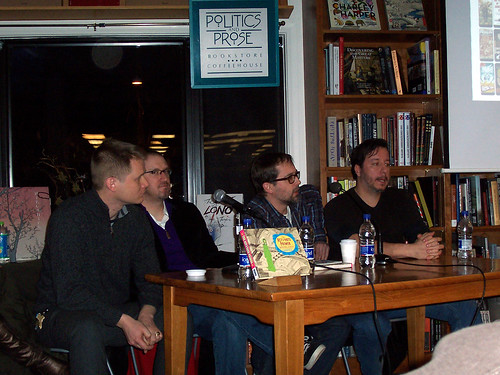
Tim Kreider recently appeared (2/8/18) at Politics and Prose's store at The Wharf to read from I Wrote This Book Because I Love You, his new book of essays. Kreider spent years as a cartoonist for the Baltimore City Paper, and is a very entertaining guy, so he's always on my list of people to see when he comes to town. With his permission, here's a transcript of his question & answer session.
Tim Kreider (TK): It is traditional, I gather, to do a Q&A after a reading, so I will gladly A, if you wish to Q…
Audience Member (AM): Are you still doing cartoons?
TK: I’m not mostly. No. I don’t know what that’s about. I did it for 12 years professionally and I got pretty burnt out on both cartooning and politics by the end of it. I was a political cartoonist. I think part of it is – my girlfriend studied opera at Oberlin, and she gave that up, because opera singers are basically not allowed to have any fun, ever. No drinking, no smoking, it’s pretty much opera all the time. She doesn’t sing karaoke either now, and I think it’s a little bit like that for me. When you devote yourself passionately to something and then you have to give it up, you have to give it up. It’s like breaking up with some one. For a while, even if you’re going to be friends later, you just cannot see them.
Also, I’m frankly glad to not be a political cartoonist right now. What would you do? One of my students told me about a form of satire that came to prominence in the late Soviet era which consisted of reciting the official propaganda and rhetoric verbatim and straight-faced – which is what we’ve come to in this country. You’ve probably heard Mark Hammill reading Donald Trump’s tweets in the voice of the Joker, and it’s impossible to believe the Joker didn’t actually write them -- they sound so much like him. I think we may be post-jokes now. “No” would be the short answer, but I miss it. There are cartoon ideas, and those are not essay ideas, and drawing is way funner than writing. You’ve got something at the end of the day that wasn’t there at the beginning of the day. Also, you can tell if it sucks just by looking at. This book [holding up his new collection]… I have no idea. No, it’s good, it’s very good.
AM: Do you have a writing process?
TK: Someone asked me that last night and it gave me my first cartoon idea in years. The caption is just, “The Writing Process” and I’ll let you imagine the process by yourself. The first year must be spent procrastinating and feeling anxious and guilty all the time. You must then undertake a series of massive secret time-wasting projects.
 Yeah, there’s a lot of that. I don’t even know how this book got written. I barely even remember doing any writing. There was always a lot of time feeling anxious and guilty. Writing a book is a marathon, rather than a sprint. I don’t know how interesting this is, but I made some rules for myself. I decided I had to have an office, so I went to the vast, ornate reading room of the New York City Public Library at 42nd St. to write my first book. It’s good to not do your work in exactly the same chair in front of exactly the same laptop where you email and watch Netflix and goof off. You have do to it on a regular schedule.
 Someone gave me the good advice that if it’s going very badly, just make yourself do twenty minutes a day. If you are not getting anything done, call it a day – go to a matinee or go to the zoo. But if you find you’ve accidentally gotten absorbed in it, then good.
I don’t know. Is that an answer to your question? I have no idea what the process is… you know what the process really is? You sit around with people smarter and funnier than you drinking beers, and remember everything smart and funny that they say, and then steal it. That’s pretty much how everything gets done. That’s my actual talent in life – cultivating friends.
AM: I think the last time you were in town [for a book event], you were still cartooning for the Baltimore City Paper, so I was wondering where and what you’re teaching.
TK: I teach at Sarah Lawrence College and I teach one of the few things I am qualified to teach. I teach writing essays, just like the ones I write. I was very resentful about having to do it at first. Writers just want to be left alone and never work an honest day in their lives. And that’s an honorable goal. At first I felt like I was a bear at a circus, having to wear a tutu and ride a bike, but it turns out that I secretly love it. I’m very fiercely devoted to my young charges and when one of my students got a piece she wrote in my class published, I was much happier then when I get anything published any more. Much. I felt like some doting grandma who wanted to tape it up on the fridge.
AM: [Are you going to write a novel or a longer work?]
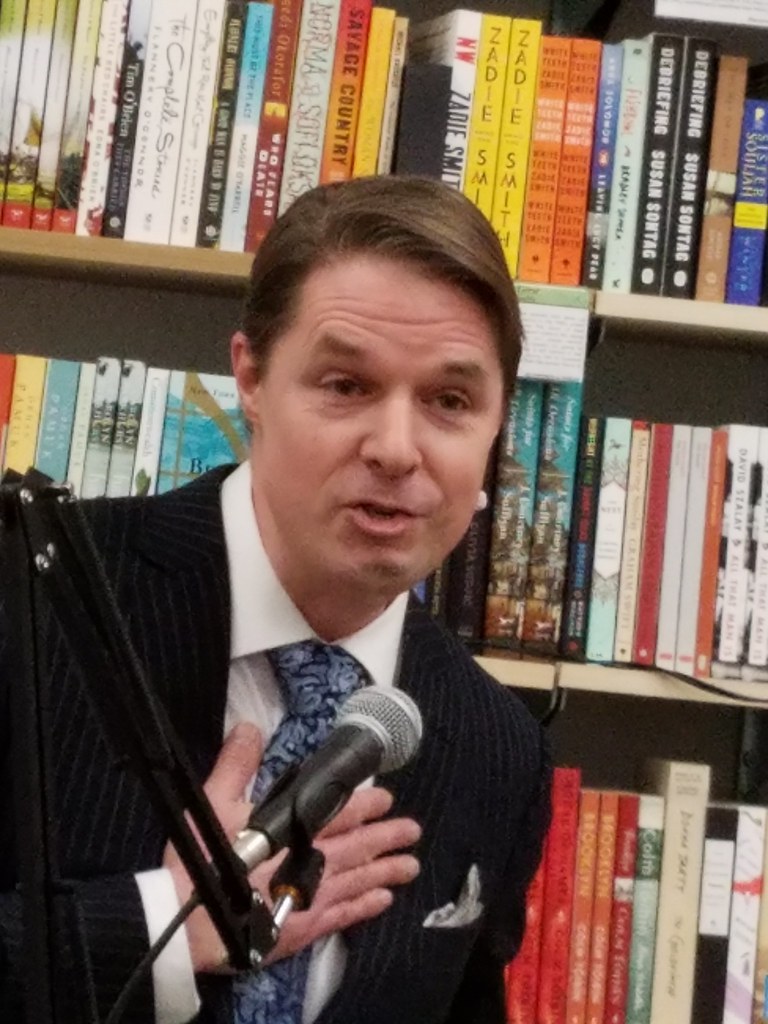 TK: I think it might be really hard… so, no. This was hard. 200 pages – it took me five years! I don’t know what idea would sustain me through that much concentration, that much focus, and that much labor. I admire the epigrams of Nietzsche. I think if you can say something in a sentence, why take a paragraph; if you can do it in a paragraph, why take an essay; and if you can do it in an essay, why take a book? There’s a nice book by Antoine de Saint-Exupéry, who wrote The Little Prince, but also wrote a great book on aviation, Wind, Sand and Stars. I’m going to paraphrase, but he’s ostensibly talking about airplanes, but you know he’s talking about writing when he says, “Somethings attain their perfection not when nothing more can be added, but when nothing more can be taken away.” I admire concision and elegance in writing, so it would have to be a subject I felt required a book. It’s hard enough just writing an essay. Some of these essays are just one year and thirty pages long and it took me years. I don’t know what would possess me to that extent, unless I got sent into space... which is what I’m angling for.
AM: How does it feel writing about something so personal? Is it cathartic? Do you not think about the audience when writing?
TK: I’m a very lazy person, and I really write about my own life because writing about other things would require research. I’m not a journalist. I was never trained in that discipline or those ethics. I’m just a guy. So all I know enough to write about is my life and stories I’ve heard from my friends, so that’s why I do that. But it comes with certain drawbacks, like, it’s weird. It’s weird to go on first dates with people who already know everything about you. I just did an interview on NPR, and it’s one thing to spend five years making a lot of calculated revelations and refining something gradually into what you hope will be art, even if the raw material is your personal life, and quite another to have some guy ask you personal questions on national radio. It turns out I’m actually kind of private [laughs]. You can’t write imaging your mom looking over your shoulder, or you would never write anything at all. Although there is an asterisk after some of the titles of essays in this book, and a note on bottom of the table of contents that says, “Note to Mom. Do not read.” Those will be the first ones Mom reads, I’m sure.
Yeah, it’s somewhat weird, but once you’re able to write about something, if you’re able to refine it to the point of being artful, you’re past it and it’s not really you anymore. There’s hazards to that; writing about something distances you from it and codifies it, and, it’s not really yours anymore in a way. There’s a trick I do in my class when we’re talking about memoir and autobiography, because they’re all young, and young people believe they are special and unique and fascinating. So this is my famous “You are not Special” lecture, which is actually a strength and not a weakness, because all the stuff you think is special and unique, and all the things you think are shameful secrets, are not. They are universal. They are boringly common. The trick I do is a thing I read about in an interview with Orson Welles, who in between being a genius director, had to do all sorts of show biz jobs. He was a stage magician and a fortune teller. He does this thing… I will do it now. I will prognosticate. I will say to someone – you have a scar on your knee… yes? So does everybody else because that’s what you fall on when you’re a kid, so we all have scars on our knees, and we all think that that is our scar. The takeaway for my students is that your secret shameful scars are everybody else’s too.
Some of my circumstances are unusual or unique, but I feel like they are illuminating way more universal conditions. I’m not pathological, I’m just weird, so I’m banking on the assumption what’s true of me is likely true of a lot of other people. I would say my experience so far is that has been rewarded. The more risks you take, the more letters you get from people effectively saying, “Oh my god, I thought it was just me! I can’t believe you came out and said that.” Which is slightly gratifying.
AM: What do your students think of your writing?
TK: [laughs] I have no idea. Those are some other people you can’t imagine looking over your shoulder while you write. The reason I wear suits is because I teach and I wear them as a kind of armor, a semiotic armor, because I felt fraudulent like most teachers secretly do when they start. I needed the students to buy into this illusion of authority. I need to affect a certain persona in class so they perceive me a certain way, but you would be doing your reader a disservice if you did that. It’s the same kind of compartmentalization that we all do in various fields of our lives, I guess.
I don’t know if many of my students have ever talked to me directly about my writing except to say, “I really liked your book; it was funny”—that kind of bland generic compliment. My hope is that I am modeling for them the kind of honesty that I try to teach. Who knows? But yes, it’s a creepy thought and I try not to indulge in it.
AM: Do you watch and lot of movies, and who are some of your favorite directors?
TK: Yeah, I watch a lot of movies. Actually, the first thing I ever got published nationally was an article in Film Quarterly. That’s where I started writing. I had a slew of articles in Film Quarterly for a while in the late 90s, early 2000s. They were about Stanley Kubrick, David Lynch, the Coen Brothers and Steven Spielberg. They were about Eyes Wide Shut and A.I. and The Straight Story and Oh Brother, Where Art Thou? I would say that my main artistic role model in life has been Stanley Kubrick, even though that seems a weird role model because he was so, in a way, absent from his own work. But of course, he’s deeply present in that he exerted freakish, fanatical control over every frame. I think I admired him not just for the beauty and the darkness of the art, but for his MO in life which is ‘secure control if you’re an artist.’ That’s a lot harder to do in Hollywood than it is in writing, because more money is involved. And more other people, and other people, as we all know, ruin everything. When you’re a writer, it’s just you and maybe an editor. Securing autonomy and control are real important to me. I know way more about Stanley Kubrick than really is healthy, but he’s someone I look to those anecdotes [about him] for little inspirational guides to conducting my own professional life.
There was a professional conflict where I was very much thinking of a certain Stanley Kubrick anecdote. It was when he was a young man working on his first Hollywood movie. He was some kid in his twenties. Some veteran photographer was working the set, and Kubrick started out as a photographer, so he knew his shit. He told the photographer the distance and the lens that he wanted, and he went on break, and when he came back it was set up at a different distance with a different lens. The guy explained to him, “Yeah, but it’s going to look the same on screen; don’t worry,” and Stanley Kubrick without raising his voice said, “Put the camera at the distance I told you to, with the lens I asked for, or get off my set.” That is utterly alien to my character, but I try to remember that to try to cultivate his discipline, because sometimes you have to be that guy, in the battlefield between art and commerce.
AM: You mentioned liking to write in the NY Public Library. What would be some of the other cultural highlights of the City for you?
TK: I was just talking about this earlier with somebody. You know, there’s a life cycle to New York. There are some people that go there and they’re lifers. They love that place, and they’re never going to leave until it gets nuked. If then. I wasn’t one of them, or didn’t think I was. I went there for the reason that a lot of young people do, which is ambition. You have a specific ambition and you go there, and you either fail or you fulfill it and then you move somewhere reasonable for a human being to live. Unfortunately, I accidentally acquired a circle of friends, and a girlfriend, and a job I like, and now I’m stuck in the most god-awful place on earth. The things I truly love there are Film Forum an art house revival theater, Grand Szechuan Chinese food (never more than twenty bucks), and yeah, I like the Metropolitan Museum of Art. I used to go only when I had out of town visitors, because you always hit the same highlights, and I started to cultivate it as a habit. You just go for half-hour… it’s basically free… well, a suggested donation… I like those things about the city. It’s a good city for depressed people. It offers constant stimulus if you require that. And it’s a good backdrop for your life, when your life is not going so well. You look up at the skyline and think “Well, Jesus, at least I’m not in Belair, MD.”
AM: It sounds like you don’t your assign your book to your students…
TK: Oh my god, no.
AM: …when you teach a class on essays, and assign good examples. Do you take much yourself from those examples? It sounds like your inspirations are more music, or movies or drinking with your friends.
TK: I read all kinds of stuff. I think I’m pretty catholic in my reading tastes. I secretly had to take a class course in essays when I agreed to teach one, so I’ve read a lot of them. I had certainly read the essays of David Foster Wallace. When I came across his ocean liner essay in Harper’s, I weirdly felt a kind of relief because back then I was a frustrated writer while being a cartoonist, and I felt, “Ok, this guy is the writer I would be if only I was a much better writer, so I’m off the hook. I don’t have to do that anymore.” But I think everybody in my generation of writers kind of felt that way. “He was speaking in the voice that everyone hears in their heads,” is the way people often put it. I read a lot of non-fiction, but you don’t learn to write by studying things for lessons. I feel that when teaching writing, you’re really just a study hall monitor. You have to make them read a lot and write a lot, and they have to do that core year, and eventually maybe they’ll be writers. You just absorb it by osmosis. You learn the rhythms of good prose. Hunter Thompson said he used to type out the last page of The Great Gatsby because he wanted to know what it felt like in your fingers to type prose that great. I make my students memorize literature, because I think you have to internalize those cadences and you have to have that in your head. I think you absorb stuff by example, unconsciously.
One of the first sentences I ever noticed as a young reader was from The Hitchhiker’s Guide to the Galaxy, and I noticed it because it wasn’t the content in the sense that it was funny; it was the way it was formed. It was when the Vogon ships, these giant rectangular spaceships come to Earth to destroy it. It’s a scheduled demolition; we just hadn’t been informed, and the sentence is, “The ships hung there in the sky in the same way that bricks don’t.” It’s nice, huh? You learn these tricks, and you file them away, thinking “Ah, I’ve got to do that,” and you just pick up about a million of those. Any wise stuff I pretend to say in class is just filling time while they are reading and hopefully learning stuff like that. Right now, I’m reading Robert Caro, the historian. I read all his volumes in the LBJ bio, and now I’m reading Power Broker about Robert Moses. He writes 800-page books which are only volume one of his series, and I write really short essays, but I feel like I’ve learned a lot from him. You are never lost reading that stuff; he turns everything into a story. You always know where you are and why you’re reading. Even the boring part of the LBJ bio, which is where LBJ grew up, what that landscape is like, he turns it into a story, and the story is, “This land is crap.” It looks incredibly fecund on the surface and it is for a couple of seasons until you denude it with crops or with cattle, and then the rains come and wash it away down to the bedrock, and you’re fucked. Ambitious people came there , and their fortunes were squandered and this is the background LBJ came from. It all ties into why that guy, who was a sociopath, cared enough to pass the Great Society bills and the Civil Rights bills. Even in the tiniest details, you understand why you’re reading this stuff. I’m sorry, I’ve gone on too long. We do that when we read the Caro books; we become colossal bores.
AM: Are there any female essayists or authors you introduce your students to?
TK: They all love Joan Didion. I don’t. Mostly because she’s humorless. I acknowledge that she’s a great writer, but I just can’t lover her because she’s not funny. It’s just my predisposition. I can’t really warm up to a writer who I don’t think is hilarious. But they love her, and I respect their judgment, so I teach Joan Didion.
The first week I always teach M.F.K. Fisher’s essays, a great food writer. I don’t care about the food at all, but she makes you understand why you should, or at least care about something passionately. I like Rebecca Solnit a lot; she’s one of my favorite political writers. And she’s not just a good political writer; she wrote a great memoir called The Faraway Nearby. I really like Lionel Shriver for her prickly, contrarian intellect. Meghan Daum is a great essayist, she wrote a book called The Unspeakable. A friend of mine introduced her work to me because she thought we were up to the same things, which is using the raw material of our own lives to try to write about universal stuff, but it was not memoir, it’s personal essay. Those are some of my top picks.
AM: What’s your impression of Washington, DC?
TK: I don’t really have a strong impression here. I’ve got a lot of good friends here, and I visit often, but I don’t really know the city. I don’t have a good sense of it as a city. I should say I’m from Baltimore, so I’m biased. I like Baltimore because it’s an eccentric, hard-drinking, dirty, insane city. And DC is not like that, to my knowledge.
AM: I find your voice refreshing and unusual for the New York Times. How did you start writing for them?
TK: I never stopped writing even while I was a cartoonist, and the reason I started writing for them is that a guy I sort of knew got something published there, and it was terrible, and I thought, “Oh, if he can be in the New York Times, I’m going to be in the New York Times.” So I wrote something for that same column and it just happened to appeal to a certain editor there. He’s my go-to guy there, and he’s also a friend, and we go out to lunch at least once every couple of months. It just happened to appeal to him personally, but it also occupied a good in-betweenish niche. It was a column on alcohol, and it seemed like everyone’s column was either “Oh man, I went out and got wasted last night,” or “I am now in a 12-step program and it has saved my life.” I was neither of those people. As someone who used to drink a lot and loved it, and now had to moderate things some, and missed it, I had all that ambivalence. I tell my students if you can find that niche in between, you’ve got a shot at getting something published. That led to me standing here, in a weird succession of events. An agent saw that, and is now my fabulous agent, and she got me a book contract, and it was all very abrupt and unexpected. It forestalled a midlife crisis for me. I’m sure it’ll come crashing later.
AM: I was wondering who is your favorite comedian?
TK: Well, some names are now taboo to speak. I don’t think I have a favorite one. I really like good standup comedians. I really like Chris Rock. I just saw Dave Chapelle’s second Netflix special which I liked, a lot, partly because he addressed his first one, which I did not see, and spoke to some of the criticisms in a way that was interesting and funny. Those are the first two that come to mind. Humor-wise, I was more into cartoonists and writers. My favorite cartoonist, B Kliban, was a guy who studied under Richard Linder, a surrealist painter at Pratt Institute, and he always continued being a surrealist. He was just a surrealist who drew cartoons. He did this famous book, Cat, in the late 70s and you saw these tiger-striped cats everywhere on dishtowels and mugs and stuff. When I was twelve I got Cat, because I made the lateral move from Garfield to Cat, and then I read his other books which had titles like Whack Your Porcupine or Never Eat Anything Bigger Than Your Head. That blew my mind, his very observant and dark humor. It took me decades to get some of those jokes. I’m still in the process of getting some. My first book is just shamelessly imitative.
Yes, Kliban has a totally different style from Linder. But I’m a teacher now, and I’m not trying to teach my kids to write in my style. Ideally, I’m trying to teach them to write as well as they can, which may be very different from mine. And sometimes you have students you’re probably not helping much because they’re too different from you.
 AM: Back when you were cartooning for the Baltimore City Paper, did you consider yourself a political cartoonist?
TK: Yeah, I did. I didn’t start out that way. I wanted to be like B Kliban and do absurdist nonsense. My first book, which is still my favorite of my books I have to say, is all that stuff, and then the 2000 election got stolen, and then 9/11 happened, and we invaded some other country that had nothing to do with 9/11 for some reason, and it felt like it would just be frivolous and unforgivable, with access to even a really tiny marginal public forum, like the Baltimore City Paper, to do art about anything else. I have some regrets about that, because those were prime creative years I squandered on a really ephemeral art form. I wouldn’t go back to it now. I feel like I did my time. It was like being conscripted in the Army in a way. It’s time for younger people to get out there.
AM: Do you recommend any African writers?
TK: Nope, I am almost entirely ignorant of the entire literature. I’ve had students complain in evaluations that my syllabus is pretty ‘white guy Western canon,’ but I suffer from the boundaries of my experience, and being sheltered, and being who I am. I have to teach the stuff that I authentically know and love, and that happens to be that stuff. I teach Montaigne and went way out of my way to find a bearable translation for them. They’re still lazy; they didn’t even like Nabokov. I should probably work to expand that canon since hopefully I’ll teach there for a long time. I don’t feel my students from other cultures are being well-served, necessarily.
AM: It took five years to write your last book; is there anything before that where you feel you totally missed the mark and would like to go back and revise?
TK: Yeah, Montaigne did that. In real scholarly editions of his work, they show which lines were written when, because he just kept going back and revising. He would think of clever things to say or a related anecdote or he would have a new thought. In fact it just happened to me. It happens all the time. This is why you can’t look at your old books. When you’re writing a book, you’re obsessed the whole time with “Is this any good or does this suck?” which is not a very useful question by the way. At some point, that stops being the relevant question, and the relevant question is, “Is it done?” and then that’s when you’re done. When it feels like the best book that the guy I was in those five years could write in that time. And we commend him for his effort and move on to the next book. Although there’s some lines I wrote in my first book that I love more than any lines in this book, but that’s probably just because I hate this book right now. That’s a bad way to end. [laughs]




 for more information about the featured panelists.