Awkward Blog

Showing posts with label comic books. Show all posts

Saturday, March 11, 2017

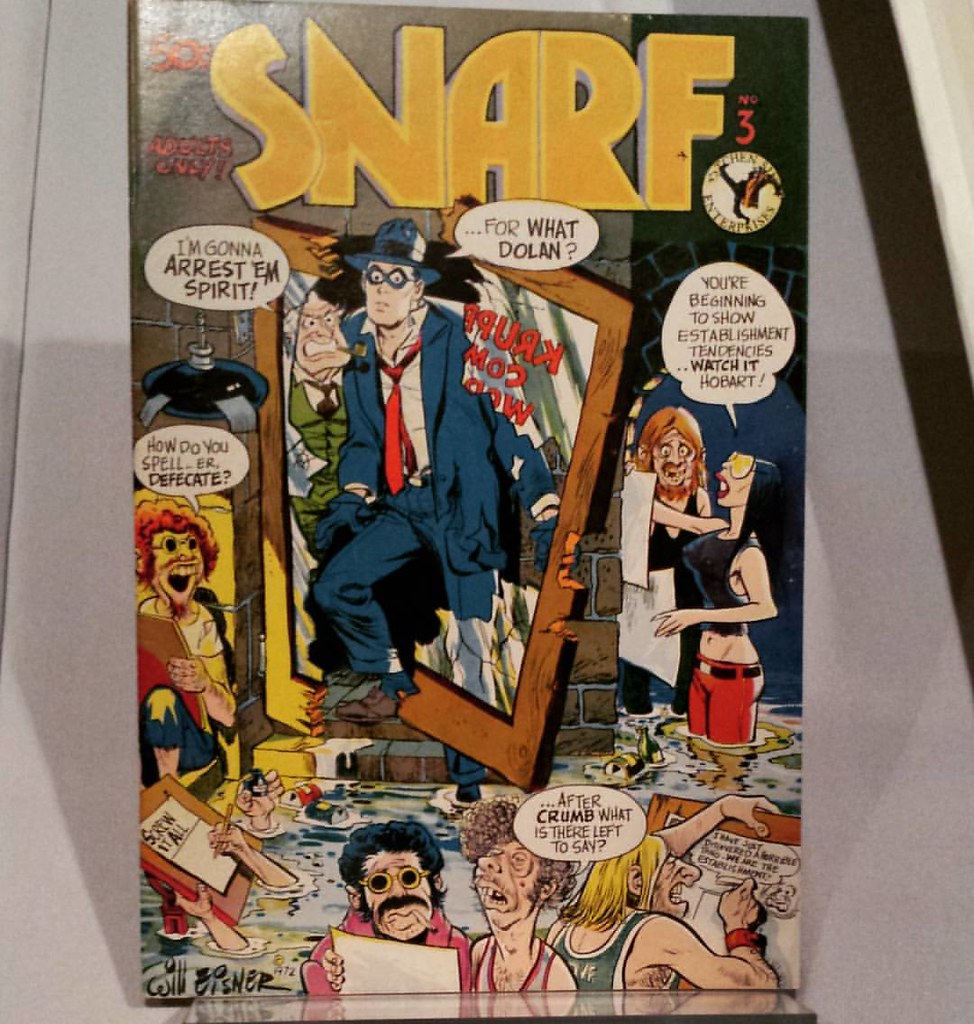
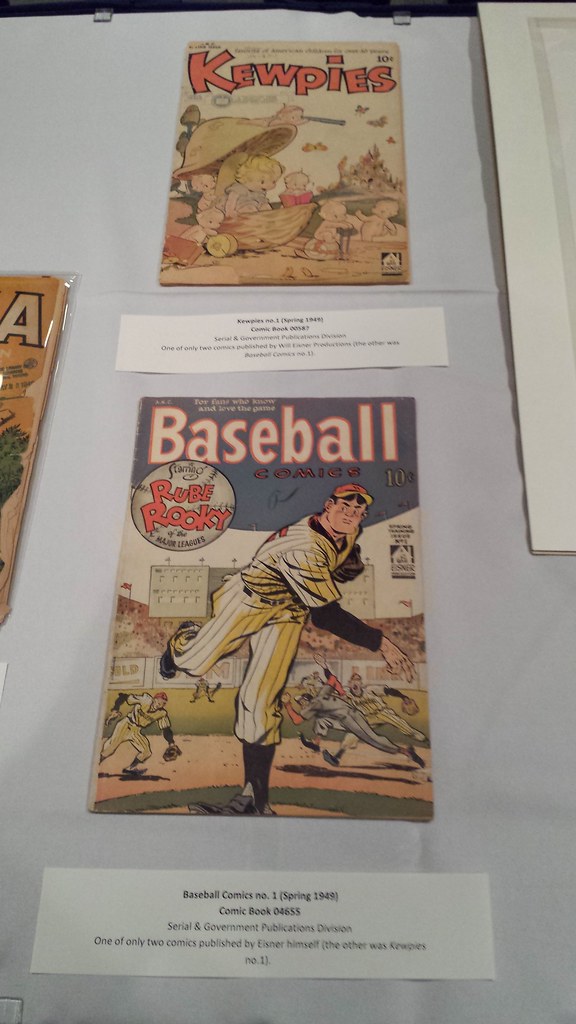
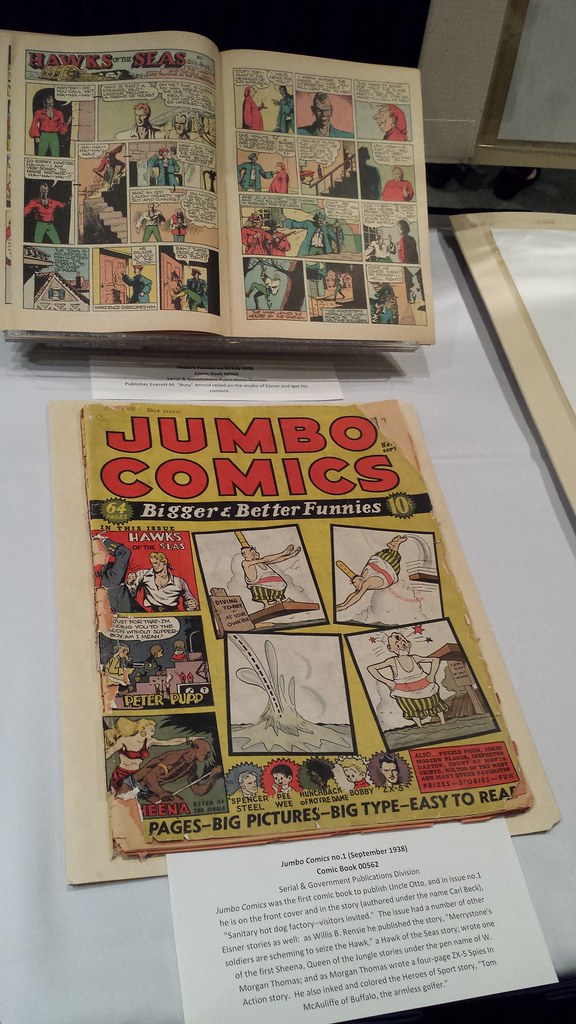
20170306_113219Last week, the departments of Serials (ie comic books) and Prints & Photographs (ie original art and posters) put on small exhibit for a couple of hours in recognition of Will Eisner's 100th birthday. In addition to Spirit comic books, there was original art by Eisner, as well as other comics and comic book pages.


20170306_113611 

 Spirited snarf at Library of Congress 

20170306_113553

More pictures are on Flickr.

Monday, February 13, 2017

by Mike Rhode

J.C. Thomas is appearing at Big Planet Comics Washington on Saturday February 18 (2-4 pm) to sign his two books. From his press release: "J.C. Thomas is a writer, artist and public elementary school teacher from Northern Virginia. His first children’s book, Ninja Mouse: Haiku, earned acclaim from both Publishers’ Weekly and The Midwest Book Review, and won a Gold Benjamin Franklin Digital Award from the Independent Book Publishers Association. He will be signing copies of Ninja Mouse: Haiku and The Gates of Dawn, an original graphic novel by Philadelphia-based writer Benjamin Finkel. Ninja Mouse: Haiku is a collection of haiku poetry with themes of martial arts philosophy and nature and includes Japanese translations. In The Gates of Dawn, a young girl with special powers and a nomadic veteran flee across a barren stretch of Utah as they’re pursued by a dark terror. Finding themselves cornered and desperate, they’re forced to make a final stand."

What type of cartooning or comic work do you do?

For now, I mostly work on one-shot, short graphic novels as opposed to serialized comics work. It’s partly a preference, partly circumstantial, and partly a product of the collaborations I’ve built in the last year or so.

How do you do it? Traditional pen and ink, computer or a combination?

I create all of my work on a custom-built PC. I use a lot of 3D models as the basis for my artwork. My main software applications are DAZ Studio, Photoshop, Octane Render, and Manga Studio. I use a Wacom Intuos for touching up line work.

I’m hoping to venture into paper and ink for some projects in the future, but for now my workflow is pretty set.

When (within a decade is fine) and where were you born?

I was born in Northern Virginia in the early 1980s.

Why are you in Washington now? What neighborhood or area do you live in?

I’m in the Washington area now because I’ve stayed here. I’m in Sterling, VA, which is about thirty minutes west of Washington. I’ve been all over, but I keep coming back to home.

What is your training and/or education in cartooning?

My “training” in cartooning is all informal. As a kid, I gobbled up every how-to book I could, from How to Draw Comics the Marvel Way to Will Eisner’s Graphic Storytelling. Scott McCloud’s Understanding Comics was also a big part of my comics “education.” I took art throughout high school but was always frustrated with the lack of respect comics art tended to be treated with.

Who are your influences?

I probably have too many subconscious influences to count, but there are some I’m more aware of. Visually, I’d have to say Alex Maleev, Jae Lee and Michael Lark are influences. I really dig their use of heavy blacks. Pacing wise, I’ve always loved the dynamic between Garth Ennis and three of his common artists: Leandro Fernandez, Steve Dillon, and John McCrea. I’d also cite Sam Esmail, the creator and director of Mr. Robot, as an influence, especially on The Gates of Dawn. The cinematography in that show had a big influence on the framing in The Gates of Dawn. Jeff Lemire is also an influence. He’s a master of knowing exactly what to draw and when to draw it, really maximizes the impact of every panel. Essex County, Lost Dogs, and The Underwater Wielder are some of my favorites of his work.

If you could, what in your career would you do-over or change?

I’d either choose to have studied something creative in undergrad, rather than International Relations, or to have studied education in undergrad. Being involved in education can really spark your creativity, and a lot of my ideas have their origins in something education-related. I wouldn’t have minded if some of those sparks were to have come earlier.

I think also I wish I had explored getting representation a bit more when I first finished Ninja Mouse. I contacted a couple of literary agents, and when I didn’t hear back within a couple of weeks, I went ahead and published it on my own. I say that with some lack of certainty, because self-publishing is great fun and very rewarding in pretty much every way except financially. But once Publisher’s Weekly released their review, agents were contacting me, but I didn’t have anything else to show them at the time. I could have probably let that play out differently and have ended up with an agent right off the bat. But the freedom that goes with being on your own is a definite perk.

What work are you best-known for?

Probably Ninja Mouse: Haiku. It received praise from Publisher’s Weekly and The Midwest Book Review, which was a pretty big deal for me at the time. It’s also the first work on I got onto Comixology, which was validating.

What work are you most proud of?

I’d have to say Ninja Mouse: Haiku again. A lot of love and work went into that project, and I was really happy with the final product.

What would you like to do or work on in the future?

Geez, what don’t I want to work on in the future? I’ve got a scifi anthology in the works that I’m anxious to finish. The second story in that project, Arcas, with writer Christopher Hutton, is almost finished and should be out in a couple weeks. I’ve also got a couple of screenplays that I plan on adapting into graphic novel format.

But the thing I’m looking forward to the most is the next Ninja Mouse project. The first book was a collection of haiku poetry about martial arts and nature, illustrated sequentially with a very loose story. The next project will be a more traditional graphic novel. I’m planning on three volumes for that one.

Other than a horde of my own projects that are in various stages of production, I’d love to do some mainstream work at some point. Batman, the Punisher, and Shang-Chi, of Master of Kung Fu Fame, are probably my favorite characters from the Big Two, and I’d jump at the chance to do work on any of them.

What do you do when you're in a rut or have writer's block?

When I’m in a rut or have writer’s block, I normally try to work on a different project. I ran into more than the average amount of ruts with Arcas, and each time I’d try to get some work done on something I’d put on the backburner. On one hand, that’s a positive of balancing a lot of different projects at once. On the other, obvious, hand, it can be distracting or can hinder my productivity to have a lot of projects going on at the same time. I also turn to music to get me out of a rut.

What do you think will be the future of your field?

That’s a good question…I don’t know, on the one hand, some trends in the industry make me think the future is looking a bit bleak. The sheer number of universe-redefining, multi-title events from Marvel and DC in the last decade or so has really turned me off from mainstream comics. I don’t really see that changing anytime soon. Don’t get me wrong, there’s been some outliers here and there that I really enjoyed. Jeff LeMire’s Moon Knight comes to mind. But in general, the big two have left me with the feeling that nothing I read matters, because they’re just going to undo and redo it again in a year. I think those types of trends will continue to alienate all but the most hardcore of fans.

On the other hand, I feel like this is a rich time for the art form in general and there are a lot of trends that make me very hopeful about the field. It seems to me there’s been an explosion of talented indie-creators and small press labels in the last five years or so. And we’re lucky to be in an area where there are retailers willing to take risks on small press titles and unknown creators. I’m also very hopeful about the genre diversity we’re seeing now. It used to be that you really had to scrounge around if you wanted to read something without capes and masks, but that’s not the case anymore. I think part of that is due to digital platforms like Comixology. I think digital comics will continue to grow, but I don’t think they’ll ever replace physical comics. I hope that someone… publishers, online retailers, I don’t know who…but I hope that someone can find a way for brick and mortar retailers to get a piece of the digital pie. I think there’s a lot of potential in apps like Madefire as well, which basically adds simple motions, background music and sound effects. It hasn’t taken off yet, probably because there are additional costs to making them and the return isn’t much more than a typical digital comic. But I think the potential is exciting.

I’m also thrilled to see the increasing acceptance that graphic novels and comics are being met with in schools and libraries. Comics have a place in literacy instruction, and more and more educators are beginning to embrace them.

What local cons do you attend? The Small Press Expo, Intervention, or others? Any comments about attending them?

I’ll be attending the NovaCon this year, which will be my first. I’m planning on attending the Small Press Expo as well. I had a chance to do a signing at last year’s FBCD at Comic Logic in Ashburn, VA, and it was absolutely packed. Like, line-around-the-building packed. I imagine something like that, but on a much larger scale.

What's your favorite thing about DC?

Diversity.

Least favorite?

The soul-killing traffic.

What monument or museum do like to take visitors to?

I have to admit that I don’t really take advantage of the museums and monuments like I should. But I really like the Freer and Sackler galleries. I also had the chance to explore Hillwood Estate recently, and that’s definitely on my short list of favorites.

How about a favorite local restaurant?

I can’t say I know a lot of restaurants in DC proper, but I love Clarity in Vienna. Mokomandy in Sterling is also one of my go-to recommendations.

Do you have a website or blog?

Sure do! It’s www.jc-thomas.com. I’d love for your readers to stop by.


Thursday, April 16, 2015

I grew up on Herb Trimpe's art, especially on the Hulk and Godzilla. I've met him a few times at cons and you can see my photos here.

John Romita Sr and Herb Trimpe at Baltimore Comic-Con 2007


Local cartoonist Shannon Gallant memorialized Herb on his blog.

Here's a longer obituary.

Monday, November 12, 2012

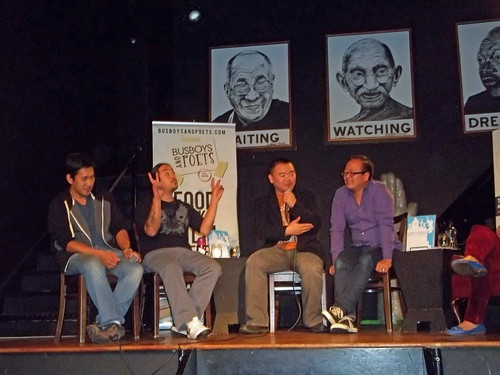
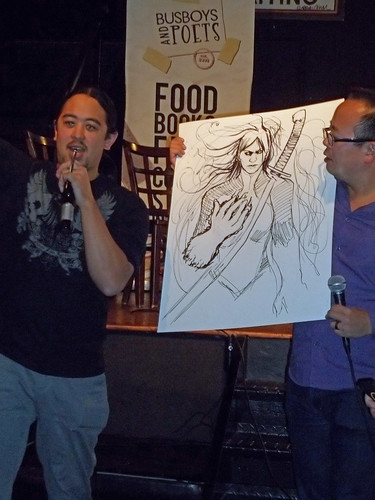
101_4620 Shattered - Michael Kang, Jamie Noguchi, Keith Chow, Jeff Yang

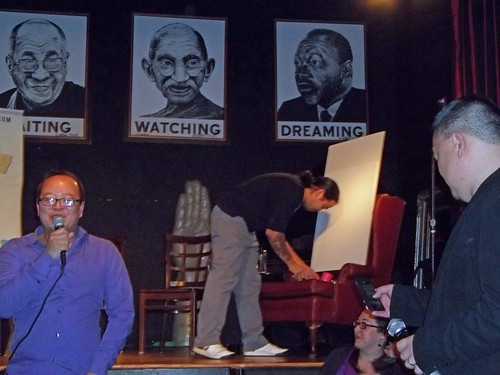
Shattered: The Asian American Comics Anthology - A Secret Identities Book - had a booksigning at Busboys and Poets, Washington, DC, with editors Jeff Yang and Keith Chow, filmmaker Michael Kang and cartoonist Jamie Noguchi. The talk went for about an hour and a half and culminated in a 'design a supervillain' crowdsourcing event. The Stain is the audience-designed character drawn by Noguchi. The talk was enjoyable. I read a few stories in the book while waiting and enjoyed the ones by Kang and Noguchi; Bernard Chang's was disappointing because it concludes online somewhere. More pictures are online here.

101_4625 Jeff Yang, Jamie Noguchi, Keith Chow

101_4631 Jamie Noguchi, Jeff Yang

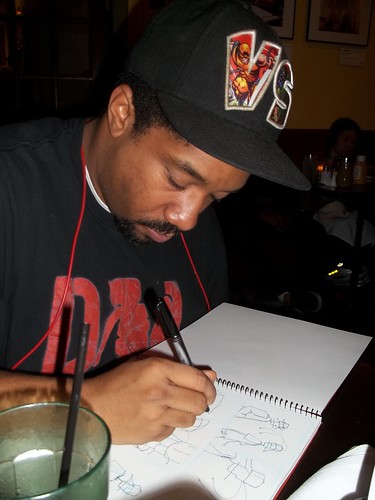
Julian Lytle who does the Ants webcomic shared my table, and multitasked by working on his strip:
101_4624 Julian Lytle

Thursday, June 14, 2012

This picture came across my desk at work today - A man in a wheelchair with his leg in a cast examines the magazine and comic book selection at Naval Hospital Beaufort's gift shop, circa 1954. Photograph courtesy of Regena Kowitz, Public Affairs Officer/Customer Relations Officer, Naval Hospital Beaufort, South Carolina. US Navy BUMED Office of Medical History 12-0064-07.
The comics that I can recognize are Betty and Veronica, The Spirit, Tip Top (featuring Peanuts), Red Ryder, Rin Tin Tin, Tarzan, Donald Duck, Love ?, Love Romances? Mighty ? - a lot of Dell books there.

Saturday, January 14, 2012

Ray Bottorff Jr reports:

WTTC Fox 5 of Washington DC, ran a promo during the NFC Divisional Playoffs Saturday evening January 14 on an upcoming special report that appears to be a Wertham-style attack on comic books.

Scheduled to air on Wednesday January 18th, on their 11:00 pm newscast, the promo presents to the audience the suggestion that comics are full of sex and violence, using the quote "Playboy meets comics."

With what sensationalized call to arms, the ad purported to show in the news story how parents can "KO" these comics for their kids.

Certainly a 30-second plug for a late night news story will not cover everything that will be mentioned during the story when it airs. But the promo certainly gave the impression that it will malign the industry and deliver the usual stereotypes on how comics are only for kids (never mind that the comics shown are not for kids), and that smut is being peddled by comic book stores to children (which they are not).

What kind of vigilance should comic book fans do to this modern day Wertham-style attack? Swamp Fox 5 with phone calls? Protest at the Fox 5 studios? Something else?


Here's the post-broadcast update.

Monday, April 11, 2011

Beyond Comics puts out a weekly newsletter, listing the new comics and the like coming  out that week.

This list caught my eye as an egregious sign that speculation is back in the comic book market:

Variant Covers
 AMAZING SPIDER-MAN THOR GOES HOLLYWOOD VAR #658
 BATMAN AND ROBIN VAR ED #22
 BLACK PANTHER MAN WITHOUT FEAR THOR GOES TO HOLLYWOOD #517
 FLASH VAR ED #10
 GI JOE VOL 2 10 COPY INCV #1
 HELLBOY BUSTER OAKLEY GETS HIS WISH MIGNOLA VAR
 IRON MAN 2.0 DJURDJEVIC VAR #3
 JOHN BYRNE NEXT MEN 10 COPY INCV #5
 JOURNEY INTO MYSTERY A ADAMS VAR #622
 JOURNEY INTO MYSTERY THOR GOES HOLLYWOOD VAR #62
 JUSTICE LEAGUE GENERATION LOST VAR ED #23
 NEW AVENGERS THOR GOES HOLLYWOOD VAR #11
 SHIELD INFINITY WEAVER VAR
 SKAAR KING OF SAVAGE LAND TAN VAR #1
 SUPERMAN VAR ED #710
 TRANSFORMERS ONGOING 10 COPY INCV #18
 TRANSFORMERS RISING STORM 10 COPY INCV #3
 ULTIMATE AVENGERS VS NEW ULTIMATES CHO VAR #3
 ULTIMATE COMICS SPIDER-MAN MCGUINNESS VAR #157
 UNCANNY X-FORCE THOR GOES HOLLYWOOD VAR #7
 UNCANNY X-MEN THOR GOES HOLLYWOOD VAR #535
 WARLORD OF MARS DEJAH THORIS 10 COPY A ADAMS VIRGIN VAR #2
 X-MEN LEGACY THOR GOES HOLLYWOOD VAR #247

...almost 25 variant covers in one week?  Not good.

Monday, March 14, 2011

Click here for part 1.


Comic Books


            The comic book itself was originally a form of merchandising comic strips.  Early magazine-style comic books, such as Proctor & Gamble's premium Funnies on Parade in 1933 and Famous Funnies in 1934, reprinted comic strips. Gulf Comics Weekly, a tabloid-sized oil company premium had begun publishing original comics in 1933 and the rest of the industry eventually followed (Beerbohm and Olson, 1999: 229).  There are thousands of free promotional comic books.  Giveaway comics are usually created to educate about or promote a company or cause.  Examples include Marvel and the American Cancer Society's Spider-Man, Storm and Powerman (1996); Disney and Exxon's Mickey and Goofy Explore the Universe of Energy (1985) and Field Enterprises and the Union Fork and Hoe Company's Miss Peach Tells You How to Grow Flowers, Vegetables and Weeds (1969).


            Comic book licensing has occurred at least since the creation of the first superhero, Superman. All of the major companies like DC, Marvel, Fawcett, Archie, Malibu and many minor ones like Cartoon Books, the publisher of Bone, have merchandising and licensing.  Some companies, like Dell were the merchandising, as they produced comics mostly based on characters and stories licensed from other media.  A modern counterpart exists in Dark Horse Comics which publishes an extensive Star Wars line among other licensed properties.  Gladstone Publishing, which, like Dell, relied totally on producing comics based on licensing, shut down in 1998.  Gladstone's owner, Bruce Hamilton, described the occasional difficulty of using licensed characters, "[Disney] keep[s] coming up with licenses that have tougher and tougher and more unreasonable demands in their boiler-plate language to the point where I have decided I am just not willing to negotiate any new licenses with them" (Spurgeon, 1998: 8).  Hamilton's experience with Disney may reflect both the current financial value and also the changing legal definitions of intellectual property, but it is the reader of comics that has lost the pleasure of these classics11.  Games such as Dungeons and Dragons and toys like the Micronauts have also become successful comic book series. 


            Of the major comic book companies, DC Comics has been among the most successful in selling their characters.  DC has been licensed so successfully that its characters are household words, rivaled only by Disney and a few other major properties such as Tarzan. 


Figure 5 Batman's world-wide popularity during the television show is demonstrated by this US Army Intelligence copy of a bootleg image on a Vietnamese nasal decongestant. Courtesy of the National Museum of Health and Medicine, Washington, D,C. (Vietnam War Collection).


The 1966 Batman television show (Figure 5) demonstrated how successful marketing could be in the increasingly prosperous and consumer-oriented America.  About the same time, Marvel Comics began merchandising its characters after the successes of Spider-Man, the Fantastic Four and the Hulk. Steve Ditko, the co-creator of Spider-Man, reportedly left the company when he did not receive a share of the licensing (Beerbohm, 1999).  Like most companies, Marvel pursued licensing and had a wide variety of products and tie-ins with its characters including television shows, Slurpee cups, Pez dispensers, toys, and other products.  In the 1990s, Marvel, after becoming a publicly-held company traded on the New York Stock Market, began aggressively seeking commercialization of its characters, and expanded its domain by purchasing sticker and trading cards companies.  Its core business of comic books also grew because of "speculators" buying multiple copies of comics for long-term investments.  When all three of these collectibles became less popular, Marvel was left in poor financial condition ("Comic Book Publisher", 1998).  After declaring bankruptcy in 1996 and being taken over by its licensing partner, ToyBiz, in 1998, the reorganized company reported,  "This [year's first quarter] increase [in sales over 1998's first quarter] was largely attributable to the inclusion of approximately $15.3 million in sales from the Licensing division and approximately $10.4 million in sales from the Publishing division, which were acquired as part of the Company's acquisition of Marvel Entertainment Group in October, 1998" (Marvel Enterprises, 1999).  In other words, the licensing, on a strict accounting level, was more profitable than publishing the comic books, but both parts of the business, which is still based on comic characters, had multi-million dollar sales.


            At times, the characters themselves become merchandise.  The survival of comic strips far beyond the life of their creator is too well known to discuss here, although a quote from the Ripley's... Believe It or Not! website is instructive: "Almost 50 years after [Ripley's] death, the Ripley's Believe It or Not! cartoon is still wildly popular; printed daily in 147 papers worldwide, in 38 countries and in 10 different languages" (Ripley's, 1999).  A similar, although less frequent, occurrence happens with comic books when a successful company purchases the creations of an unsuccessful rival.  DC Comics has been especially active in purchasing characters, including Blackhawk from Quality and Captain Marvel from Fawcett, both of which were "seamlessly" integrated into what is currently known as the DC Universe.  For a short time in the 1990s, DC licensed and published Archie Comics' superheroes from the 1960s under their Impact! imprint.  This trend towards the commodification of characters in comic books can also work in favor of some creators who, since the 1980s, have been able to own their characters12.  Many characters have now been published by multiple companies who essentially licensed the character from the creator.  Teenage Mutant Ninja Turtles, perhaps the ultimate self-published merchandising success story13, has recently been published by Archie and Image companies.


            Even unlikely sources lead to licensing empires.  EC's 1950's horror comics were licensed extensively 45 years after their creation due to the success of the television series, Tales from the Crypt in 1989.  These are the same comics that were originally considered so gruesome that they were indicted in the anti-comics movement (Diehl, 1996).  EC's Mad Magazine, putatively an anti-establishment, anti-commercialization comic, at least based on its editorial stance, resisted the trend for years, but eventually succumbed.  As William Gaines said, "A lot of people have one way of looking at [merchandising Mad]: like 'Peanuts' is merchandised to its eyeballs...I don't object to that, except that a magazine like Mad, which makes fun of people who do that -- it doesn't seem proper for us to do it ourselves" (Reidelbach, 1991: 174).  Mad's long-term drop in circulation eventually led them to licensing.  With Gaines' death and Mad's complete incorporation into the Time-Warner conglomerate, the process has accelerated with Alfred E. Neuman and Spy vs. Spy action figures now available in comic book stores.


Figure 6 Kitchen Sink's candy bar illustrated by Crumb's Devil Girl proved surprisingly popular and was followed by more underground candy.

Possibly the most unlikely source, underground comix creator Robert Crumb has been heavily merchandised in recent years (Richter, 1995).  Crumb, as a counter-culture icon, had seen his "Keep on Truckin" image appropriated without any compensation nearly three decades ago. In the 1990s, and especially with the release of the movie Crumb, Kitchen Sink Press extensively used his oeuvre in ways not entirely expected, such as the Devil Girl candybar (Figure 6). Kitchen Sink, on the other hand, barely survived over-extending itself on merchandise for the second Crow movie in 1996 and in 1999 found itself taken over by the candy side of its business (Riley, 1997).


            In recent years, due to the direct market, comic book publishers, readers, and store owners  have concentrated more on the collectibility aspect of comics and companies have been formed to take advantage of that niche. Graphitti Designs, whose motto is "Quality Licensed Products Since 1982," exists solely to merchandise existing characters from other companies.  In 1994 they were producing "screen-printed shirts, limited edition books and prints, sculpted statues and busts, cloisonne and sculpted pins, compact discs, and embroidered caps"; among these were a $195 Vault-Keeper Statue (from Tales from the Crypt), three Batman T-shirts, 2 Superman T-shirts, a Rocketeer Club pin, a Vampirella T-shirt and three Akira books priced at  $49.95 each (Chapman, 1994).  Graphitti Designs advertises itself as vital to a comics retailer: "Many comics consumers do want more than just the comics. Ancillary products have the ability to also attract a clientele beyond the traditional comics reader. People will walk into a comics store displaying cool media-related shirts or other peripheral products even though they don't read comics" (Chapman, 1995).   This positive view is affirmed by Big Planet Comics store owner, Joel Pollack, who said, "I think overall [merchandising] is a good thing.  It's a great way to publicize the characters."  Big Planet Comics, in Bethesda, Maryland has been in business for 13 years, weathering several downturns in the comic book market so Pollack's opinion is indicative of business realities (Pollack, 1999). 


Adaptations in other media


            It is possible to draw a difference between adaptations in other media and the plain licensing of a character for a toy or food.  Superman is a prime example having been adapted into a comic strip (thus recapitulating his original creation); a novel -- Superman by George Lowther (1940); a radio show (1940-1951); an animated movie short series by the Fleisher Brothers (1941-1943); movie serials14 (1948 and 1950);  a live action television series (1953-1957); a Broadway play -- It's a Bird... It's a Plane... It's Superman (1966); an animated television series (1966-1969); a hit movie and sequels (1979-1987); a second animated television series (1988-1989); another live action television series -- Lois & Clark: The New Adventures of Superman (1993-1996); and most recently, a third animated television series (1996-1999).  Any of these adaptations could be successful and enjoyed by an audience that did not read Superman comic books.  Adaptation of Superman to other media became a necessity by the 1990s when the comic book's sales figures were regularly below 100,000 copies sold.  Adaptations can frequently inject new life into a property as seen by the introduction of Perry White, Jimmy Olsen and Inspector Henderson and the invention of kryptonite in the Superman radio show (Tollin, 1997: 1-2), Superman and Lois Lane's marriage in Lois & Clark, and the arrival of a new successor to Bruce Wayne as Batman in Batman Beyond.


            Successful comic strips are turned into comic books .  Literally dozens of strips, such as Flash Gordon, Popeye, Dick Tracy and the Phantom have had original stories published in comic books.  Batman, Superman, the Hulk, Spider-Man, and Marvel's version of Conan are among those that have been made into strips, some multiple times.


            Theater adaptations began almost immediately after the creation of the comic strip.   They continue to the present day.  Winchester's studies of plays show that many were produced from 1894-1930 including multiple, different road shows of the Brownies, the Yellow Kid, the Katzenjammer Kids, Happy Hooligan, Buster Brown, Mutt and Jeff, and Bringing Up Father.  This was followed by a lull when most adaptations were done as radio shows or films.  The three decades from the 1950s to the 1980s saw major adaptations such as You're A Good Man, Charlie Brown and Annie.   In recent years, smaller shows adapting unconventional work such as Crumb's have predominated (Winchester, 1993).  

Figure 7 Kudzu: A Southern Musical is one of the latest in a long line of plays adapted from the comics.

Doug Marlette's Kudzu was produced in Ford's Theatre in 1998, while being advertised in his comic strip (Figure 7).  Neil Gaiman's work is frequently adapted and a version of Signal To Noise has been staged in Chicago as a fund-raiser for the Comic Book Legal Defense Fund (Spurgeon, 1999).


            Adapting comics into prose has been popular whether in Little Golden Books (children's books with simple prose and large illustrations), Big Little Books (alternating text and drawings), or adult novelizations.  Hundreds of prose works featuring dozens of characters have been created.  Most novelizations are made from movie adaptations of comics, but Marvel Comics currently has a successful original novel series (O'Hearn, 1998).


            Radio, as a popular medium, arose concurrently with comic books and the two shared a cast of characters.  Comics characters with radio shows included Batman, Buster Brown, Dick Tracy, the Green Lama, Hop Harrigan, Little Orphan Annie, Mandrake the Magician, Red Ryder, Skippy, Superman, Terry and the Pirates, and certainly others (Tumbusch, 1989).  Most adaptations were between the 1930s and early 1950s, but from 1995 to 1996 National Public Radio aired Ben Katchor's Julius Knipl, Real Estate Photographer.  Most radio shows were not perceived as having long-term value and some were permanently lost, but The Adventures of Superman is currently being reissued by the Smithsonian (Tollin, 1997).  Radio shows generated a vast amount of "secondary" merchandise - premiums or giveaways based on a character's adapted version, and not the original comics creation15.  As Smith (1982: 40-41) noted:


Ovaltine gave away more premiums on its radio shows, Orphan Annie and Captain Midnight, than any other radio sponsor.  Entire warehouses of paraphernalia -- shake-up mugs that made 'a picnic out of every meal,' identification tags 'like real soldiers and aviators wear,' buttons, photos, games, masks, pins, rings, badges, bandannas, booklets, bracelets, coins, cutouts and maps - were shipped out to listeners..."


            Literally hundreds of movies -- thousands if one includes animated shorts -- have been made from the comics.  The seven live-action Happy Hooligan shorts done in 1900 by director J. Stuart Blackton are probably the first.  Most adaptations were made into series of shorts or serials;  Blondie starred in twenty-eight B-movies from 1938 to 1950.  Television usurped this role in the 1950s when Dick Tracy, Flash Gordon, Joe Palooka and Dennis the Menace began appearing.  Movies like the 1966 Batman starring the television cast were still made, but usually with larger budgets than television could afford.  Superman (1979) and Superman II (1981), which were essentially filmed at the same time, became the model for licensing.    Both movies together had 200 licensees, including Warner Publishing,  producing 1,200 products.  Superman made $140 million dollars in film rentals for Warner Bros. which distributed the movie.  Superman II  had already sold $100 million worth of overseas tickets before the movie opened in the United States.  The initial movie also galvanized support for creators' rights, becoming the lever which shamed the company into giving Joe Siegel and Jerry Shuster, the Superman creators who had signed away their rights to Superman for less than $200, a lifetime pension of initially $20,000, a "gift" of $10,000, and lifetime medical coverage.  The two also received a credit line on future uses of Superman (Harmetz, 1981; Sherwood, 1975).


12.  Due to both a creators' rights movement that began in the 1970s and an increase in the number of publishers, some characters are owned by their creators.  Creators who design new characters that are firmly a part of the companies' "universe" are usually compensated for them now.  Marv Wolfman's current lawsuit against Marvel Comics reveals past practices (Dean, 1999).

13.  Kevin Eastman and Peter Laird self-financed the publication of their black & white first issue in May 1984.  They issued a press release that was picked up by UPI and they quickly sold out their first issue.  Eventually the Turtles had "more than five hundred licensees in some thirty countries producing more than nine hundred Turtle products," including an animated television series, three movies, and toys (Wiater, 1991: xv-xix).  To their credit, they put some of their licensing money back into comics through Tundra, the Words & Pictures Museum and Xeric grants.

14.  Tollin (1997: 2) notes that the serials "were adapted from the Superman radio program broadcast on the Mutual Network" and not the comic book. 


Click here for part 3.
Saturday, November 27, 2010

...the fool!

Pop Culture Happy Hour: We Give Thanks, Try Comics, And Debate Happiness
by Linda Holmes
National Public Radio's Monkey See blog November 26, 2010
http://www.npr.org/blogs/monkeysee/2010/11/26/131609227/pop-culture-happy-hour-we-give-thanks-try-comics-and-debate-happiness or

http://public.npr.org/anon.npr-mp3/npr/blog/2010/11/20101126_blog_pchh.mp3

Saturday, July 17, 2010

At Fort Fringe, X-Men mark the spot for 'Superheroes Who Are Super'
By Fiona Zublin
Washington Post July 15, 2010

Thursday, April 8, 2010

It Pays To Enrich Your Nerd Power: What Kids Learn From Comics

by Glen Weldon

National Public Radio's Monkey See blog April 7 2010

- even more nerdy? His title is a play on Reader's Digest old feature, It Pays To Enrich Your Word Power.

Tuesday, April 6, 2010

I wasn't all that concerned about them actually, but my editor asked for an article - Shannon Gallant, John Gallagher, Matt Wuerker and Ann Telnaes ventured opinions for me - In D.C. and Industrywide, Will the iPad Save Comics and Kill Print? by Mike Rhode on Apr. 6, 2010.

Said editor, Jon Fischer, drastically cleaned up this article too and made it much more readable.

Sunday, November 29, 2009

SL (Shannon) Gallant has written in to introduce himself, and look for fellow artists. I've got to say that I've never bought GI Joe in my life (although I liked the small comics they used to package in their toy sets in the 1960s), but now I'll be picking it up

I'm a comic artist-illustrator living in DC and currently working for IDW on G.I. Joe. I've also worked for DC, Dark Horse, Marvel, and Titan UK in the past on titles ranging from Marvel Adventures:The Avengers and Torchwood to more cartoon oriented work such as Shrek and Monsters vs Aliens.

The last few months I've been making the effort to create connections with other artists in the area, through DC Conspiracy and other groups. I was hoping you might know similar professionals in the region I should try to get in touch with who are less likely to participate in such outings?

So if you're a comic book professional in the area, feel free to post below. Send me news of your current and upcoming projects and I'll promote them as well. I know my co-author Randy's compiled a list of local people at one point - does he still have that?

Saturday, July 25, 2009

QUICK REVIEWS FOR COMICS DUE 07-29-09
By John Judy
CITIZEN REX #1 of 6 by Mario and Gilbert Hernandez. “What compels life without a soul?” No, it’s not a biography of Dick Cheney. It’s a sci-fi adventure about a scandalized robot in a world he never made. For fans of LOVE & ROCKETS and good comics everywhere. Recommended.
DARK REIGN CROSS-OVERS by Tons o’ People. Let’s see, there’s HAWKEYE, HOOD, LETHAL LEGION, SINISTER SPIDER-MAN and YOUNG AVENGERS. Go completists, go! It’s feeding time at the DARK REIGN trough! Good luck!
DETECTIVE COMICS #855 by Greg Rucka, JH Williams III and Cully Hamner. Batwoman and the Question do the detecting thing and look really good doing so. Hey, if you’re gonna call yourselves Batwoman and/or the Question you better be at the top of your game. Otherwise people will talk.
FANTASTIC FOUR #569 by Mark Millar and Stuart Immonen. The Marquis of Death must pay for his treatment of Doom! And for being French!
GARTH ENNIS BATTLEFIELDS: TANKIES #3 of 3 by Garth and Carlos Ezquerra. It’s end-game as the lads must finally face the deadly German tiger tank. Riveting wartime adventure. Recommended.
GHOST RIDER: LAST STAND SC by Jason Aaron and Tan Eng Hut. Continuing Aaron’s run on this hellfire and booze-fueled cycle circus originally published in GHOST RIDER #26-32.
IGNITION CITY #4 of 5 by Warren Ellis and Gianluca Pagliarani. Mary Raven’s in the firefight of her life armed with naught but her dead dad’s raygun and her own spunk to see her through. Bet on the Ellis uber-chick.
JUSTICE SOCIETY OF AMERICA #29 by Bill Willingham, Matthew Surges and Jesus Merino. A new creative team adds two new characters to the JSA roster. But will they last?
KID COLT #1 by Tom DeFalco and Rick Burchett. It’s a Tom DeFalco comic and a Western. That makes it twice as unusual in today’s market.
NEW AVENGERS #55 by Brian Michael Bendis and Stuart Immonen. It’s a new issue and Brother Voodoo is still the sorcerer supreme. And you thought Bucky America was a lot to accept.
NORTHLANDERS #19 by Brian Wood and Danijel Zezelj. “The Shield Maidens” wraps up with the ladies inflicting some serious choppage. Highly recommended.
NORTHLANDERS, VOL. 2: THE CROSS AND THE HAMMER SC by Brian Wood and Ryan Kelly. Collecting Northlanders #11-16. An Irishman rebels against his Viking rulers. It’s awesome. Highly recommended.
PREVIEWS by Marvel and Diamond Comics. See what you’ll be reading, wearing and playing in three months time!
STUFF OF LEGEND #1 of 2 by Mike Raicht, Brian Smith and Charles Paul Wilson III. In 1944 a small boy is dragged into his closet by the Boogeyman. Now it’s up to his toys to go in and rescue him. Great fun for reading at bedtime, especially if the kids have been naughty. Gotta look!
SUPERMAN #690 by James Robinson and Renato Guedes. Mon-El: Still dying.
THUNDERBOLTS #134 by Andy Diggle and Miguel Angel Sepulveda. Be honest, did anyone ever think Songbird would be so tough to kill? I mean, her name is “Songbird” for crying out loud! And now it’s like Wolverine and Keith Richards had a kid and he wasn’t a tattooed, mohawked moron! I digress… Good comic, worth a read or three.
ULTIMATUM #5 of 5 by Jeph Loeb and David Finch. The last issue. Lots of people dead. For now.
ULTIMATUM: SPIDER-MAN REQUIEM #2 of 2 by Brian Michael Bendis, Mark Bagley and Stuart Immonen. Ultimate J. Jonah Jameson continues his weepy eulogy for Ultimate Almost Certainly Dead Spidey.
WEDNESDAY COMICS #4 of 12 by Lotsa Awesome People. So ya say ya want Hawkman by Kyle Baker? Metamorpho by Neil Gaiman? A Kamandi adventure in the style of Prince Valiant? We have that and a lot more! Metal Men! Flash! Green Lantern! It’s a smorgasbord! Highly recommended.
WONDER WOMAN #34 by Gail Simone and Aaron Lopresti. It’s WW and Black Canary! What a pair! Recommended!

Wednesday, July 22, 2009

Zadzooks: Comic book reviews, Sub-Mariner, Wednesday Comics and more," Joseph Szadkowski, The Washington Times July 22, 2009.

Sunday, July 19, 2009

QUICK REVIEWS FOR COMICS DUE 07-22-09
By John Judy
AMAZING SPIDER-MAN #600 by Lotsa People, including Stan the Man, Mark Waid, Dan Slott and JR Jr. It’s an all-new, no reprints anniversary issue featuring 104 pages of web-slinging wonderment! Read it!
ARCHIE #599 by Stan Goldberg and the Gang. It’s the last one before #600, Riverdaliens! This one features three stories including “Return to Riverstock” in which the gang commemorates the 40th anniversary of a certain music festival. Fun for all ages.
AVENGERS INITIATIVE #26 by Christos Gage and Rafa Sandoval. Norman Osborn is taking the old Mr. Miyagi’s Little Tree Initiative and turning it into the evil Cobra Kai Initiative. Because he’s EVIL!
BEANWORLD VOL.2 HC: A GIFT COMES written and drawn by Larry Marder. Collecting the final twelve issues of this unique and imaginative series.
BLACK PANTHER #6 by Reginald Hudlin and Mitch Brietwieser. The final battle with Morlun, Devourer of Totems! Please, god, let this be the final battle with Morlun, Devourer of Totems…
BOYS: HEROGASM #3 of 6 by Garth Ennis and John McCrea. A death at Herogasm! And not a little one either. Not for kids. Recommended.
CAPTAIN BRITAIN AND MI13 #15 by Paul Cornell and Leonard Kirk. The final dust-up between Dracula and all the limey super-spies he hasn’t already killed.
CREEPY ARCHIVES, VOL. 4 HC by Various Creators. Collecting issues 16-20 of this classic horror series with a spooky/fabulous cover by Frank Frazetta. Nice!
DETHLOK VS THE GOON ONE-SHOT by Eric Powell and Brandon Small. No, it’s not the Marvel cyborg from the future. The Goon is mixing it up with the greatest American/Scandinavian death-metal band in the world, DETHLOK!!! Thank-you, Dark Horse. Thank-you Adult Swim. Gotta look!
FINAL CRISIS: LEGION OF THREE WORLDS #5 of 5 by Geoff Johns and George Perez. Hey, ya remember FINAL CRISIS? Me neither, musta been retconned out of my brain. Nevertheless, here straggling across the finish-line after all the other FC titles and cross-overs have showered, gone home, gone back to work, married and had babies is FCLOTW #5! Enjoy!
GREEN LANTERN #44 by Geoff Johns and Doug Mahnke. Black Lantern Jonn Jonzz is back from the dead and looking to eat what he kills. At least he no longer looks like a Skrull. Now he looks like Thanos.
HELLBLAZER #257 by Peter Milligan and Giuseppe Camuncoli. Featuring a cover by Simon Bisley suggesting John Constantine is now working as a greeter at Abercrombie and Fitch. Rated “A” for abs.
IMMORTAL WEAPONS #1 of 5 by Jason Aaron, Duane Swierczynski and Many Talented Artists. It’s the story of Fat Cobra so you want it! It’s by Jason Aaron so you need it! Highly recommended.
INCREDIBLE HULK #600 by Jeph Loeb and Ed McGuinness. Spidey’s gonna try and find out who the Red Hulk really is. Yeah, he’s gonna try…. SPOILER: He’s Michael Jackson.
PROJECT SUPERPOWERS CHAPTER TWO #1 by The Alex Ross Factory. Because some of you still haven’t learned…
RICHARD STARK’S PARKER THE HUNTER HC written and drawn by Darwyn Cooke. Donald Westlake’s first Parker novel adapted by comics master Cooke. Yeah, you need this, especially if you enjoyed the movie “Payback” with Mel Gibson and Maria Bello. Highly recommended.
WEDNESDAY COMICS #3 of 12 by Various Awesome Folk. Now this is the weekly series DC should have been doing for the past couple of years! Beautiful, serialized stories presented in glorious tabloid format. Even my least favorite of the strips (“Wonder Woman! Cough! Cough!”) looks amazing. This is one to share with your friends, especially if your friends publish newspapers with comics sections. Highly recommended!
YOU HAVE KILLED ME HC by Jamie S. Rich and Joelle Jones. From Oni Press and the creators of 12 REASONS WHY I LOVE HER, this is a noir tale to remind all us hard-boiled private dicks why it’s a bad idea to take your ex on as a client.
YOU SHALL DIE BY YOUR OWN EVIL CREATION SC by Fletcher Hanks and Paul Karasik. This is the sequel volume to 2007’s deeply disturbing and entertaining I SHALL DESTROY ALL CIVILIZED PLANETS and completes the collection of golden-age writer/artist (and monster) Fletcher Hanks. Publisher Fantagraphics has generously provided a 13 page preview on their website http://www.fantagraphics.com/. Highly recommended.

Saturday, July 11, 2009

QUICK REVIEWS FOR COMICS DUE 07-15-09
By John Judy


ACTION COMICS #879 by Greg Rucka, James Robinson, Fernando Dagnino and Cafu. Nightwing! Flamebird! Captain Atom! The reasons one buys ACTION COMICS!

AGENTS OF ATLAS #8 by Jeff Parker and Carlo Pagulayan. The AoAs meet the Hulk. Smashing ensues.

ALL-SELECT COMICS #1: 70th ANNIVERSARY SPECIAL by Marc Guggenheim and Javier Pulido. The Blonde Phantom is “gorgeous, quick-witted and hard-boiled!” I think I used to date her. Nefarious schemes will be foiled, believe you me! Plus a golden-age reprint and Marvex the Super-Robot! Recommended.

AMAZING SPIDER-MAN #599 by Joe Kelly and Marco Checchetto. For some reason this has Richard Nixon on the cover. Hey, the last time Spidey had a President on the cover it went to seven printings or something. Marvel ain’t no dummy.

BATMAN: WHATEVER HAPPENED TO THE CAPED CRUSADER HC by Neil Gaiman, Andy Kubert and Others. “Ummm, he got kilt?” It’s Neil doing his dreamy funeral thing. Looks good too. Plus other Gaiman Bat-tales. All good.

BLACKEST NIGHT #1 of 8 by Geoff Johns and Ivan Reis. “The dead shall rise!” Or as we say here in Comics-Land: “It’s Wednesday!” If your favorite hero snuffed it in the past few years they’re probably here looking corpsey. Gotta look!

CAPTAIN AMERICA #601 by Ed Brubaker and Gene “The Dean” Colan. Those two names in the credits should tell you how good this book is. Highly recommended.

CREEPY COMICS #1 by Many Talented Horror-Meisters, including Angelo Torres and Bernie Wrightson. It’s back from the publishing graveyard and ready to eat your brains in glorious black and white! For fans of the original mag and those who weren’t even born back then. Featuring two painted covers by Eric Powell. Yum!

DAN DARE OMNIBUS VOL. 1 TP by Garth Ennis and Gary Erskine. Collecting the cult favorite mini-series that brought the British space hero out of retirement in every possible way. Good stuff.

DARK AVENGERS #7 by Matt Fraction and Simone Bianchi. The DAs throw down with the X-gang in San Francisco. Big fight.

INCOGNITO #5 by Ed Brubaker and Sean Phillips. The penultimate issue of this beautiful anti-heroic ditty. Too good to wait for the trade. Highly recommended.

LITTLE MOUSE GETS READY HC written and drawn by Jeff Smith. A children’s book from the creator of BONE, RASL and SHAZAM: MONSTER SOCIETY OF EVIL about a little mouse who gets ready. Tell yourself you’re getting it for your kid. Recommended.

MIGHTY AVENGERS #27 by Dan Slott and Khoi Pham. A new story of a king so vile he had to be written out of history, but only after he screwed up traffic all over LA with his memorial service. Dan Slott is rocking this title. Highly Recommended.

RASL #5 written and drawn by Jeff Smith. Our dimension-hopping science thief gets in even more trouble. This one keeps getting better. Recommended.

SCALPED #30 by Jason Aaron and R.M. Guera. Red Crow learns there’s an FBI agent on The Rez as Dash Bad Horse begins the countdown to Totally Screwed. Not for kids. Highly Recommended. Read it.

UNWRITTEN #3 by Mike Carey and Peter Gross. Tommy Taylor meets Frankenstein! How great is this book? Very-very! Highly recommended.

WALKING DEAD #63 by Robert Kirkman and Charles Adlard. The scary non-zombies are hunting our intrepid band. Let’s hope Michonne chops ‘em up good. Not for kids. Recommended.

WEDNESDAY COMICS #2 of 12 by A Pantheon of Comics Dieties. Tabloid-sized awesomeness every week to remind you of how great a newspaper comics section could be. No lie, this stuff could save newspapers if they picked up on it. Highly recommended!

X-FACTOR #46 by Peter David and Valentine DeLandro. Time travel and girl-fights, but the big news is that Rictor and Shatterstar are gay. In other news, water is wet.

www.johnjudy.net

Saturday, July 4, 2009

QUICK REVIEWS FOR COMICS DUE 07-08-09
By John Judy


100 BULLETS, VOL. 13: WILT SC by Brian Azzarello and Eduardo Risso. Collecting the final issues of the series, 89-100, in which questions get answered and secrets get turned over in their graves.

AMAZING SPIDER-MAN ANNUAL #36 by Marc Guggenheim and Patrick Oliffe. It’s a wedding in Spideyland and don’t those always go well? But who will catch the webby bouquet?

BATMAN #688 by Judd Winick and Mark Bagley. Judging by the cover of this book the new Batman appears to have been shot in the face with… something… And that’s really all I think I’m going to say about that.

BPRD 1947 #1 of 5 by Mike Mignola, Joshua Dysart, Fabio Moon, and Gabriel Ba. So, BPRD 1946 wasn’t enough for ya, Fanboy?! Well, how about THIS?!?! Featuring Nazis and other monsters.

DARK X-MEN: BEGINNING #1 of 3 by James Asmus, Paul Cornel and Humberto Ramos. Y’know, I hate to say it but the Dark X-gang sound like the most intriguing line-up of mutants I’ve seen in a long time. Except for Wolver-Lad, but few comics are perfect. Gotta Look!

GREEN LANTERN #43 by Geoff Johns and Doug Mahnke. The Black Hand is raising the dead to form his Black Lantern Corps. Guess who’s first? Recommended.

NO HERO #6 of 7 by Warren Ellis and Juan Jose Ryp. The continuing adventures of our tragic, castrated, largely psychotic super-chap from that nice Mister Ellis.

THE NOBODY HC written and drawn by Jeff Lemire. The Xeric Award-winning creator of THE ESSEX COUNTY TRILOGY re-imagines H.G. Wells’ story of “The Invisible Man” in graphic novel form. Recommended, especially if you miss the old rascal from LEAGUE OF EXTRAORDINARY GENTLEMEN.

NORTH 40 #1 of 6 by Aaron Williams and Fiona Staples. An interesting look into what happens when some dummy uses a magic book without knowing what he’s doing and turns a Midwestern American county into Hell on Earth. It’s a lot like when Texas first elected Governor Bush.

PUNISHER: FRANK CASTLE MAX #72 by Victor Gischler and Goran Parlov. Frank vs. cannibal rednecks in the Bayou. The wild card appears to be a huge freakin’ alligator who eats frat boys on command. Anyone else wanna see the gator get his own book? Recommended. Not for kids.

THE STAND: AMERICAN NIGHTMARES #4 of 5 by Roberto Aguirre-Sacasa and Mike Perkins. This “End of the World by Super-Flu” story remains top-notch morbid entertainment. Stephen King should be writing this creative team a sincere thank-you note because they’re handling his novel better than any of the TV movies ever did. Recommended.

SUPERMAN: WHATEVER HAPPENED TO THE MAN OF TOMORROW HC by Alan Moore, Curt Swan, Murphy Anderson and Others. Don’t let the title fool you. This is not merely another re-printing of the title story, but also a deluxe hardcover including Moore’s other two Superman classics “For the Man Who Has Everything” from ACTION COMICS ANNUAL #11 and “The Jungle Line” from DC COMICS PRESENTS #85. Highly Recommended.

SUPERMAN WORLD OF NEW KRYPTON #5 of 12 by James Robinson, Greg Rucka and Pete Woods. You would think a world as advanced as New Krypton would have moved beyond caste systems and the death penalty. But you would be wrong. Typical behavior from people too dumb to listen to their leading scientist when he tells them the world’s going to end… Recommended.

UNWRITTEN #3 by Mike Carey and Peter Gross. Wow, is this a great book, mixing the best traits of the Harry Potter novels, Alan Moore and Neil Gaiman with a twist of mystery and illustrated to the nines by Peter Gross. Read it! Recommended.

WEDNESDAY COMICS #1 of 12 by Many, Many Amazing Writers and Artists. This one is too big to sum up in a Quick Review. Just trust me that this is the most awesome thing on the stands this week and you need to sell a kidney if that’s what it takes to add it to your stack. Highly Recommended Times a Million.

X-MEN LEGACY #226 by Mike Carey and Dustin Weaver. Some old X-Men return to San Francisco only to encounter the new Dark X-Men. You would think that a group calling itself “The Dark X-Men” would stir some measure of mistrust, but you would be wrong. Because this is America and we watch a lot of TV.

www.johnjudy.net

Thursday, July 2, 2009

Zadzooks: Comic book reviews, Batman, Aliens and more
Magneto's origins revealed
By Joseph Szadkowski
Washington Times July 1, 2009

Sunday, June 28, 2009

Bennett's Best for the week of June 14
June 24, 2009 Zadzooks blog

Bennett's Best for the week of June 21, 2009
June 25, 2009 Zadzooks blog

Both by Greg Bennett of course.