Awkward Blog

Showing posts with label Charles Schulz. Show all posts

Sunday, May 13, 2012

I stopped into the MARVA matchbook club meeting yesterday to hand off some old matchbooks (as you know, I love ephemera) and the group was very welcoming. They usually have piles they trade amongst themselves as everyone has to specialize. I found a few of cartoon interest:
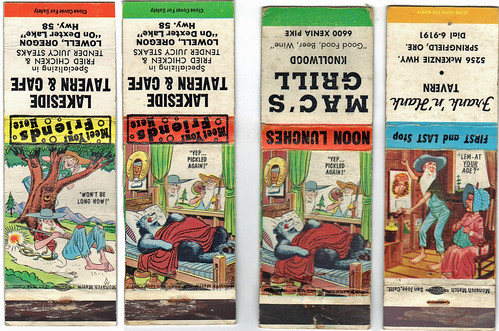
matchbooks - 1940s cartoons
3 hillbilly gag cartoons, probably from the 1940s or early 1950s, on matchbook covers.
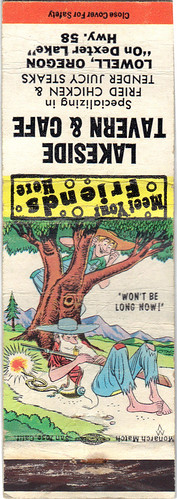
Matchbooks - won't be long now
"Won't Be Long Now" hillbilly cartoon gag on matchbook cover.
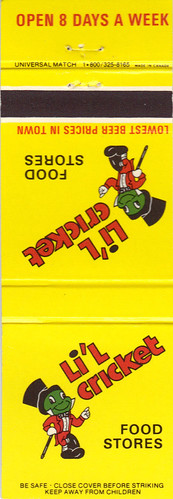
matchbooks - Cricket not Disney
A cricket that looks a lot like Disney's Jiminy on a "Li'l Cricket Food Stores" matchbook cover.
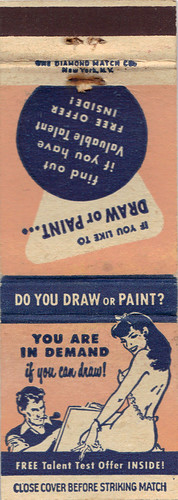
matchbooks Art Instruction
Matchbook ad for Art Instruction, Inc, the school that Charles Schulz attended (via correspondence) and taught at before Peanuts.
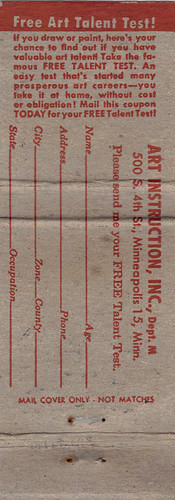
Matchbooks Art Instruction reverse
Interior of matchbook ad for Art Instruction, Inc, the school that Charles Schulz attended (via correspondence) and taught at before Peanuts.
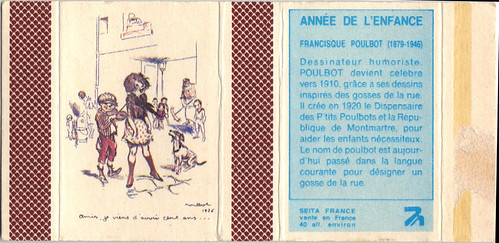
matchbooks - Francisque Poulbot of France
Cartoon matchbook spotlighting French cartoonist.


ANNÉE DE L'ENFANCE [aka, Année internationale de l’enfant : 1979]

Francisque Poulbout (1879-1946)
Dessinateur humoriste, POULBOT devient célèbre vers 1910, grâce à ses dessins inspirés des gosses de la rue. Il crée en 1920 le Dispensaire de P'tits Poulbots et la République de Montmartre pour aider les enfants nécessiteux. Le nom de poulbot est aujourd’hui passé dans la langue courante pour désigner un gosse de la rue.

Translation by Portugese comics scholar Leo de Sa:

INTERNATIONAL YEAR OF THE CHILD [1979]
Francisque Poulbout (1879-1946)
Cartoonist, POULBOT became famous around 1910, thanks to his drawings inspired by street kids. In 1920 he created the Dispensary of Little Poulbots and the Republic of Montmartre to help needy children. The name "poulbot" became the everyday-language designation for a street kid.


Sunday, August 22, 2010

National Portrait Gallery Presents Portrait of Charles M. Schulz to Commemorating the 60th Anniversary of "Peanuts" Debut

A photograph of “Peanuts” creator Charles M. Schulz (1922–2000) will be presented to the Smithsonian’s National Portrait Gallery in a ceremony for invited guests Oct. 1. The event recognizes the cartoonist’s impact on millions of people worldwide and coincides with commemorations surrounding the 60th anniversary of “Peanuts.” The 1986 photograph, created by acclaimed portraitist Yousuf Karsh, is the Portrait Gallery’s first image of the famed cartoonist. In the image, Schulz is at his drawing board with pen in hand. Before him is a partially completed “Peanuts” full-page comic featuring the perennially popular story line in which Lucy snatches the football away from Charlie Brown and sends him hurtling through the air. The photograph, with the accompanying original comic strip, will be on view to the public immediately following the ceremony in the museum’s “New Arrivals” exhibition.

“The Portrait Gallery has many editorial cartoonists and their cartoons in its collection, but this is the first of Charles Schulz and his adored characters,” said Martin Sullivan, director of the museum. “Schulz dealt with life’s everyday moments with humanity and humor.”

On Saturday, Oct. 2, the museum will host a friends-and-family day for all ages with programs inspired by the cartoonist and his characters. Snoopy will be available for photographs; Joe Wos, cartoonist in residence at the Schulz Museum in Santa Rosa, Calif., will offer workshops throughout the day; and Sean Lane and the Bay Jazz Project will provide musical entertainment. Children will be invited to join the band to play percussion instruments. Later in the day, the museum will screen the popular “Peanuts” special It’s the Great Pumpkin, Charlie Brown. Lee Mendelson, a longtime friend of Schulz and executive producer of all the classic “Peanuts” specials, including Great Pumpkin and A Charlie Brown Christmas, will be on hand for a discussion and to answer questions from fans.

The Smithsonian’s National Museum of American History will also mark the 60th anniversary of the “Peanuts” strip with a case that will feature objects from Schulz, including drawing utensils, an animation cell from the television special It’s the Great Pumpkin, Charlie Brown and two comic panels that show the cartoon’s progression from rough pencil sketches to finished ink strips.

Schulz once described himself as “born to draw comic strips.” A Minneapolis native, he was just two days old when an uncle nicknamed him “Sparky,” after the horse Spark Plug from the “Barney Google” comic strip. Throughout his youth, he and his father shared a Sunday-morning ritual of reading the funnies. After serving in the army during World War II, Schulz got his first big break in 1947 when he sold a cartoon feature called “Li’l Folks” to the St. Paul Pioneer Press. In 1950, Schulz met with United Feature Syndicate, and on Oct. 2 of that year, “Peanuts,” so named by the syndicate, debuted in seven newspapers. Schulz died in Santa Rosa, Calif., Feb. 12, 2000—just hours before his last original strip was to appear in Sunday papers.

“Peanuts,” one of America’s most beloved comic strips, ran without interruption for nearly 50 years. Encores of the comic strip appear today in more than 2,200 newspapers in 75 countries and 21 languages. “Peanuts” animated specials have become seasonal traditions, and thousands of consumer products are available. Charlie Brown kicking the football, Linus and his blanket and Lucy leaning over Schroeder’s piano are images to which everyone can relate. Phrases such as “security blanket” and “good grief” are a part of the global vernacular.

The photograph of Schulz has been donated to the National Portrait Gallery by Estrellita Karsh, in memory of Yousuf Karsh.

Thursday, August 19, 2010

Because a prophet is without honor in his own land, go to Alan Gardner's Daily Cartoonist to see the details on a photograph of Charles Schulz that's being donated to the National Portrait Gallery. One may also read their press release.

Wednesday, May 14, 2008

From the May 6th chat:

Comi, KS: The current Doonsbury replacement strip, despite the fact that I can't remember its name, has been pretty good. I thought this week's strip was hillarious -- but I'm 39 and I'm barely barely old enough to remember the "Hey, Kool-aid!" ad campaign. Was there a later resurgeance that I missed out on? Or does nobody under 35 stand a prayer of understanding that joke? Seems like the punch line--so to speak--would have worked a lot better in 1978 than 2008.

Gene Weingarten: Yeah, I barely remembered it. I like this strip, though it is one of the more blatant Far Side ripoffs around.


----------------------

and later in the chat,

The Four To, PS: OK, how about the Mount Rushmore of cartoonists?

I think Walt Kelly and Charles Schultz have to be there, but then it gets harder. I have to go with Watterson next, but then that last spot is very, very tough -- my list of possibles includes Feiffer, Trudeau, Breathed, Larson, Hollander, Adams, and MacGruder, all of whom were groundbreaking in different ways.

Who goes on your mountain?

Gene Weingarten: I take Schulz off the list and put Larson and Trudeau up there, but you won't get that many to agree. I don't think you can take Kelly off the list, but both Larson and Trudeau belong there. I am in the minority in my views on Schulz.


Re: Mount Rushmore of Cartoonists: Which weighs more heavily in your decision on this: artistic or writing talent?

Gene Weingarten: Writing. Though Kelly may have been the best cartoon artist ever.

Larson couldn't draw. He still needs to be there.

--------------------

Palookaville: Hey, Gene, can we have a moment of silence for Ted Key, who died recently at 95? Key created Hazel (the Saturday Evening Post cartoons from which the TV show was spun), Diz and Liz and -- which I hadn't realized -- Sherman and Mr. Peabody. An American giant.

Gene Weingarten: I didn't know he did Sherm and Peabody! And Hazel was good, too. Very dry humor. Hazel, as I recall, was a maid with a dry, cynical sense of humor, who basically controlled the household.